37 The basis of our confidence in the Bible’s moral authority (Part 3)

To continue this discussion of the basis of our confidence in the Bible’s moral authority, we can demonstrate much more simply that the Bible appears to have been composed in much the same way as other literary products not attributed to the action of God, and so its authority does not come from a magical character. We do not need to settle definitively the questions of cosmogony (“how the world began”) or eschatology (“how the world ends,” presumed to be the subject of much biblical prophecy) that are likely to be the subjects of perpetual debate among readers of the Scriptures. We may simply observe the biblical writers at work.

At one point in his epistle, for example, the author of Hebrews is trying to warn his readers against spiritual complacency. The metaphor he chooses is “striving to enter God’s rest.” To demonstrate that “there remains a sabbath rest for the people of God,” he quotes the opening section of the book of Genesis, where it is written, “And God rested on the seventh day from all his works.” The only problem is, the author of Hebrews doesn’t seem to remember exactly where this is written, so he introduces this quotation by saying of God, “he has somewhere spoken of the seventh day in this way” (emphasis added).

If our expectation of the Bible is that it came about through a process that is qualitatively distinct from the normal process of composition, in that God inspired and aided the authors, would it not be reasonable to anticipate that God would at least have helped this author remember that the statement he wanted to quote came from one of the most conspicuous passages in all of the Hebrew Scriptures? If God were going supernaturally to override ordinary human weaknesses in the composition process in order to signal a divinely inspired product, this would have been an awfully good place to intervene!

But it is not the only such place. Paul confesses to imperfections of memory on his own part, even as he is composing what we consider an inspired epistle, when he writes to the Corinthians, “I do not know whether I baptized anyone else” besides Crispus, Gaius and the household of Stephanus (1 Cor. 1:14-16, emphasis added).

His admonitions to these same Corinthians about marriage provide another insight into the “ordinary” process of composition behind this epistle. He prefaces these various admonitions with statements about the source of their authority. “To the married I give charge, not I but the Lord, that the wife should not separate from her husband,” he says at the beginning of his discussion (1 Cor. 7:10). But shortly afterwards he writes, “To the rest I say, not the Lord,” that a believing husband should not divorce an unbelieving wife (v. 12). And he later writes, “Now concerning the unmarried, I have no command of the Lord, but I give my opinion as one who by the Lord’s mercy is trustworthy” (v. 25).

It is important to explain that when Paul writes “the Lord says,” or speaks of a “command of the Lord,” he is referring to statements of Jesus on various subjects passed down to him through Christian tradition (as in 1 Cor. 11:23, “I received from the Lord what I also passed on to you”). He is not speaking of a direct revelation from God to him on a subject about which he was seeking guidance.

So the contrast here is not between (1) subjects on which God had “inspired” him and (2) those on which God had not sent inspiration but on which Paul was writing anyway. (This would constitute evidence that the Bible, by its own admission, is not uniformly inspired!) Rather, the contrast is between (1) instruction passed down from Jesus and (2) instruction that Paul is giving “as one who by the Lord’s grace is trustworthy.” In neither case does he consciously understand or describe himself to be inspired as he writes, even though the church has judged him to have been inspired as he wrote. Indeed, even within his own generation, the apostle Peter classified Paul’s letters with “the other Scriptures” (2 Peter 3:15-16). But in whatever way Peter, as an inspired writer himself, recognized Paul’s epistles as Scripture when he read them, it was not because he saw that Paul always knew just what to say because God told him directly as he was writing.

The end of 1 Peter and the beginning of 2 Peter in the Papyrus Bodmer (c. 3rd Century A.D.), the oldest source for Peter’s second epistle, in which he describes Paul’s letters as “Scriptures.”

Nor was it because Paul never made a mistake, even when he was referring to the earlier Scriptures themselves. When he was warning the Corinthians against immorality, for example, he appealed to the experience of a previous generation of Israelites and wrote, “We must not indulge in immorality as some of them did, and twenty-three thousand fell in a single day” (1 Cor. 10:8). The chastising plague Paul is referring to is described in Numbers 25, but we discover there that the total of its victims was actually twenty-four thousand. Some have suggested that the confusion arose in Paul’s mind because immediately afterwards a census is reported and the tribe of Levi, which was instrumental in stopping the plague, is reported to have had twenty-three thousand men of fighting age (Num. 26:62). But whatever the explanation, Paul got the number wrong, contrary to what we would expect if we understand “inspiration” to mean a divine overruling of the normal composition process, a process that ordinarily does include such lapses of memory.

Some Christians are so insistent, however, that inspiration must consist in such divine intervention that they have developed elaborate theories to account for phenomena such as the “missing thousand” of 1 Cor. 10:8. It has been asserted in all seriousness, for example, that the actual number who fell in the plague was 23,500, and that the author of Numbers is rounding up, while Paul is rounding down. There are many obvious objections to this assertion. Paul knew about the plague only by reading the Scriptures, where the number given is 24,000, so he really never faced the question of whether to round 23,500 up or down. Even if someone were to make the extreme claim that God supernaturally revealed the real number to Paul, why would he, as an inspired author, have rounded down, when the earlier inspired author had rounded up? What is the “inspired” way to handle a half-thousand? It seems to be different in the case of two different “inspired” authors. What this proposal is ultimately saying is that the Bible gives the wrong number in two places, not just one!

But what is most dangerous about such proposals is that they create a “meta-text,” that is, another version of events beyond that of the Bible’s. This “meta-text” ends up saying things that the Bible doesn’t say anywhere, such as that 23,500 fell in the plague, or that Jesus cleansed the temple twice. (This explanation is adopted to account for John’s description of the cleansing at the beginning of Jesus’s ministry even though Matthew, Mark and Luke place it at the end.) But even though it says things the Bible doesn’t say, this meta-text possesses greater authority, because the Bible is made answerable to it. We thus surrender the Bible’s supreme authority while trying to establish its inspiration, if we insist on understanding inspiration as divine intervention in an otherwise natural process.

36 The basis of our confidence in the Bible’s moral authority (Part 2)

In my last post, I argued that when biblical writers such as Matthew speak of a prophecy being “fulfilled,” they don’t mean that a foreseen future  has come to pass. Rather, they mean that sayings or events from an earlier point in the biblical story have taken on a fuller and deeper meaning in light of later redemptive-historical developments.

We may appeal to American history for an illustration of this sense of “fulfillment.” When Thomas Jefferson wrote in the Declaration of Independence in 1776 that “we hold these truths to be self-evident, that all men are created equal,” he said this to challenge the premise that kings rule by divine right and that their subjects therefore ow them the kind of unquestioning loyalty they would offer to God. (That is, he said this to justify a revolutionary independence movement.)

But when Abraham Lincoln observed in his Gettysburg Address of 1863 that our nation was “dedicated to the proposition that all men are created equal,” he meant instead that slavery was incompatible with the fundamental premises of American society.

And when Martin Luther King said, in his “I Have a Dream” speech of 1963, appropriately delivered from the steps of the Lincoln Memorial, that he longed for the day when our nation would “rise up and live out the true meaning of its creed: ‘We hold these truths to be self-evident; that all men are created equal,’” he explained that in such a nation, people would “not be judged by the color of their skin, but by the content of their character.” This is how the “true” or “fulfilled” (fullest and deepest) meaning of Jefferson’s words would be realized, according to King.

The Rev. Dr. Martin Luther King, Jr., greets the March on Washington for Jobs and Freedom from the steps of the Lincoln Memorial, Aug. 28, 1963.

By this same analogy, in Matt. 1:23 the gospel writer is announcing that Isaiah’s words have taken on a fuller and deeper meaning. The Greek translation of Isaiah’s original words has helped this happen: Isaiah uses the term “maiden.” (The original Hebrew term refers to a young woman, married or unmarried, who has not yet had a child; in Isaiah’s original context, it probably indicates Ahaz’s queen, who became the mother of Hezekiah.) The Greek reads, more intensively, “virgin.” Moreover, “Emmanuel” is no longer the boy’s name, but rather an explanation of his identity — “God with us.” These two intensified aspects of meaning are brought out when the original statement is heard in the light of later developments as the plan of God unfolds.

The case is similar with “out of Egypt have I called my son.” “Son” is no longer a metaphorical description of the nation of Israel, but another accurate disclosure of Jesus’ identity.

As for “he shall be called a Nazarene,” the best explanation seems to be that this was a geographic term of derision (as in John 1:46, “Can anything good come from Nazareth?”), much like “Okie” during the Dust Bowl years. This term “Okie” was applied to people from Oklahoma and nearby areas similarly affected by prolonged drought who migrated West in search of work and food. It ceased to mean “someone from Oklahoma” and came to mean something closer to “gypsy.” Matthew, in his appeal to the prophets, is summarizing their many statements that the servant of God would be “despised and rejected.” (The quotation here is indirect, not direct like the preceding ones, and thus does not belong within quotation marks, although some modern Bibles present it that way.) Other announcements of prophetic “fulfillment” may be understood similarly.

None of this should be taken to mean, however, that those who knew God could not have spoken in prescient ways about the deliverance He would send. They were able to do this, and did so, precisely because they knew the ways of God. Moreover, we must not rule out the existence of an actual “gift of prophecy,” given to humans, through which God discloses details of what He will work to bring about in the future, so that those in the present may take moral warning.

One clear example of prophecy-as-foreseeing is the prediction a prophet made to Jereboam, recorded in 1 Kings 13:2, that a king named Josiah would one day defile the altar he had built to rival the one in Jerusalem. This prediction was fulfilled, not in the Matthean sense, but quite literally, three hundred years later, as described in 2 Kings 23:15-18. Another example is Jesus’ prediction that Peter would deny him three times before the cock crowed the following morning (Luke 22:34 and 54-62, with parallels in Matthew and Mark). Jesus’ estimate of Peter’s impetuous character could certainly have led him to predict that despite his bravado, Peter would deny him. But how would Jesus have known, without divinely-granted insight, how many times, and by when? So there are indeed examples in the Bible of prophetic fulfillment in the sense of “a future foreseen come to pass.”

Nevertheless, these examples do not provide proof of the supernatural inspiration of the writer who recorded them. They take place, after all, within a single continuous narrative that has been recorded after the fact. So they are not offered to demonstrate prophetic insight on the part of the writer. These predictions and fulfillments are rather recounted for other reasons. The far-off but inevitable doom of Jereboam’s altar is proclaimed from its very foundation as a warning against idolatry. And Jesus’ prediction about Peter shows that even as he went to his death, he was full of divine power and knowledge, and that it was therefore willingly that he surrendered himself for our sakes. The account is meant to fill us with gratitude and admiration for Jesus, in other words—not for Luke!

As we seek to understand the Bible’s concept of “fulfillment,” we must also recognize the significance of “intertextuality,” that is, of the new meanings texts take on when they are read in the presence of other texts. For the Christian who believes that the Bible is the inspired word of God, one implication is that it is God Himself who has juxtaposed the texts in question. Divine intention can therefore be seen in connections that would have been impossible for the original authors to have made, since they wrote far apart from one another in both time and place.

The word spoken to the serpent in Genesis 3:15, for example, “I will put enmity between you and the woman, and between your seed and her seed; he shall bruise your head, and you shall bruise his heel,” may have meant in its original context only that animals formerly subject to humans would now turn wild and dangerous. But within the pages of the biblical collection, there is now an intertextuality by which these words can be understood validly as a Messianic prophecy, even though the New Testament itself does not make this connection expliclity. This prophecy was fulfilled by the victory of Jesus over the devil at the cross.

But if such “fulfillments” are instead to serve as our guarantee of the divine inspiration of the Scriptures, all of them, without exception, must be examples of uncannily accurate prediction. It simply does not suffice for Isaiah to look 700 years into the future, see a boy miraculously born to a “maiden” or “virgin,” but then get his name wrong. We have a right to expect better than this from God, if we are looking for supernatural proofs.

And if what we think should be happening really isn’t, then we must re-examine our expectations themselves. Has God really promised us that his word can be recognized as his word even without faith? Did not Jesus say that it is “an evil and adulterous generation that seeks a sign” (Matthew 12:39)? If no such signs were granted in the case of the living Word, we should not expect them in the case of the written word, either.

35 The basis of our confidence in the Bible’s moral authority (Part 1)

God gives rain upon the earth and sends waters upon the fields.”

God made the heaven and the earth and the sea and all that is in them.”

“All Scripture is inspired by God.”

These three statements in the Bible all have something very significant in common. They all attribute to a supernatural cause, the action of God, results that appear, the more closely one studies them, more and more to have come about through natural processes. That is, these results look just like other results of their respective processes which are not said to have come about through the action of God. This does not mean that God is not the actor in these three cases; it simply means that God has not chosen to use a radically different process to bring about what is nevertheless a divine product.

We have already considered, in an earlier post, that rainfall in the land of Palestine (the rainfall that is arguably in view in statements such as the one quoted above) is produced by the same process as the rain that falls on other parts of the world. We have also seen in earlier posts that the biological diversity that results from a process even the strictest creationists would consider “natural” rather than “supernatural” (“variation within ‘Genesis kinds’”) is quantitatively and qualitatively equal to, if not greater than, the diversity that results from what is understood to be divine activity (“special creation”).

In this post and the three that follow, we will also establish that the Bible, for its part, bears all the marks of having been produced through the same process as human writings that are not considered divinely inspired. Once we have seen this and accepted it, we shall be free to ground our confidence in the Bible’s moral authority, which will still be entirely justified, on something other than the inevitably disappointing premise that it bears magical signs pointing to its divine origin.

My co-author has already discussed one of these sought-after signs. He has related how he was taught that God supernaturally gave the biblical authors natural-scientific insights far transcending the observations it was possible for them to make within their limitations of time, place and culture. He faced deep disillusionment when he discovered that the biblical authors’ statements about the origins of the natural world—when read literally, non-contextually, and cumulatively, in keeping with the approach characteristic of those who appealed to them as a sign—could not in any way be considered “accurate” by scientific standards. When he came to appreciate the beauty and truth of these statements within the observational, phenomenological perspective from which they had actually been made, this offered some reassurance about the statements themselves, but a substitute was still lacking for the role they had once been asked to play.

Before proceeding further with our discussion, it is instructive to recognize that even if the authors of the Bible had been given a supernatural awareness of true cosmology, and even if they had reflected this awareness in their writings, this would still not have provided an attestation of the Bible’s inspiration for just about any of its readers over the centuries. This is because, until the Copernican Revolution, the readers of the Bible held the same observational cosmology it actually presents. They would therefore have dismissed the Bible as inaccurate if it had instead painted a picture of a spinning earth and a stationary sun.

Nicolaus Copernicus’ model of the earth, moon, sun, and known planets from his 1543 work On the Revolutions of the Heavenly Spheres. A stationary sun and a moving earth were revolutionary concepts that explained the observed motions of heavenly bodies much more accurately and elegantly.

Indeed, there is actually no cosmology that could have been put in the Bible that would have provided an attestation of its inspiration to any but a tiny fraction of its eventual readers. A Copernican cosmology would have been considered outdated in Kepler’s day; Kepler’s cosmology would not have provided an attestation in the present day; and it is virtually certain that even if the Bible presented a cosmology identical to the one we now believe to be accurate, a few hundred years from now this, too, would raise the same question we are addressing.

The human understanding of cosmology has continued to grow and change over the centuries to such an extent that there is no period whose cosmology is correct by the standards of other periods. An observational cosmology, however, when it is recognized as such, travels to all periods, and was thus the best choice for the Bible itself. Even if God had somehow revealed the true cosmology to all humans right from the start, even this would not have permitted cosmology to provide an attestation of the Bible’s inspiration, because in such circumstances its cosmological insights, however true, would be nothing special.

Another “sign” that is often pointed to as proof of the Bible’s divine inspiration and consequent moral authority is the accurate fulfillment of the prophecies it contains. How could the biblical writers have known the future, the argument goes, if they had not been inspired by God? But once again, if we look closely and carefully at what the Bible means when it speaks of its own prophecies being “fulfilled,” we discover that there is no magical testimony to the Bible’s divine authorship in this case, either.

We do not have to look very far to make this discovery, in fact. The very first book of the New Testament, in its very first claim that a prophecy was fulfilled, rules out the understanding of “fulfillment”—a foreseen future coming to pass—to which appeal is typically made to demonstrate the Bible’s inspiration.

Matthew writes that when Mary had borne a son, and Joseph had called his name “Jesus,” the prophetic word was fulfilled that said, “Behold, a virgin shall conceive and bear a son, and his name shall be called Emmanuel” (Matt. 1:22-25). We would expect that if Isaiah 7:14, the passage referred to here, really were a future foreseen and described, Mary would have actually named her son “Emmanuel,” not “Jesus.” So something different is happening here.

The early chapters of Matthew present several other problems along this same line. In Matt. 2:23, for example, it is said that Jesus dwelt in Nazareth to fulfill what was spoken by the prophets, that he would be called a Nazarene. Yet nowhere in the prophetic corpus, nor indeed anywhere in all of the Hebrew scriptures, is such a prediction recorded.

And when Jesus’ flight into Egypt and return to Israel after Herod’s death is said to fulfill Hosea’s words, “Out of Egypt have I called my son” (Matt. 2:13-15), the reader is puzzled indeed, because Hosea is writing history, not predicting the future, when he makes this statement. He is describing the Exodus (Hos. 11:1).

The necessary conclusion is that when Matthew speaks of “fulfillment,” he does not mean that a foreseen future has come to pass. Instead, he means that words spoken at an earlier time in redemptive history have taken on a fuller and deeper meaning in light of later, more developed redemptive-historical circumstances. This, to me, is actually a much more powerful concept: not that humans were given an advance glimpse of what was going to happen in the future, but that the God who superintends and overrules human affairs has demonstrated His unchanging character consistently through time and has revealed more and more of his purposes while reaffirming the earlier-revealed ones.

A Coptic-style icon of the Flight into Egypt by the Bulgarian artist Yordanka Karalamova. Matthew says that this event “fulfilled” Hosea’s prophesy, “Out of Egypt have I called my son.” But Hosea made that as a historical statement describing the Exodus several hundred years before.

34 Observational cosmology, observational cosmogony?

Various people who read our manuscript in the months and years after we first wrote it raised questions that we agreed we would need to address further. These readers granted that the “two ways of knowing” we were describing might be complementary and even compatible. But how did their results fit together? The questions raised were not scientific ones about natural-historical observations and their interpretation, nor were they biblical ones about texts and their meaning. Rather, they were essentially theological questions.

They raised such issues as how there could have been death (arguably necessary for a process dependent on natural selection) before the emergence through that process of humans who disobeyed God and through that action, according to the Bible, first brought death into the world. Other questions included whether the evolutionary process itself was really of such a character that the God of the Bible could make use of it, and whether the biblical portrayal of the natural world as “fallen” from a previously better state is consistent with an evolutionary description of life having taken on greater and greater complexity through an uninterrupted process.

As these questions accumulated (and the issue of the Bible’s moral authority remained outstanding as well), I began to feel I should share some more reflections in order to address them, even though this meant there would be significant non-autobiographical material in our book after the end of my narrative. With my co-author’s agreement and with encouragement from early readers, I have done just that. Consequently, after I narrate here one more significant episode in my personal pilgrimage of understanding the Scriptures and their description of God as Creator, in future posts I will offer discussions of the grounds for our confidence in the Bible’s moral authority and of the three theological questions just described.

As word spread in my Williamstown congregation about the book Stephen and I were writing, more and more parishioners, particularly college students, engaged me on the subject of origins. Many were concerned about how to establish a correspondence between specific details in the Genesis account and natural-historical occurrences, as if Genesis provided a capsule history of the natural world in symbolic language. To convince them that they didn’t need to look for such a correspondence, I found myself appealing over and over again to the fact that the Bible is written from an observational perspective.

For example, the Bible doesn’t explain to its readers that the sun’s apparent motion is actually due to the rotation of the earth. Rather, it describes very accurately how things appear: The sun seems to “rise” and “set.”   In the same way, it speaks of the sky in the way it appears, as a solid dome over a flat, circular earth that is surrounded by seas. And it speaks of water being above this dome and falling through it as rain. We need look no farther than this to explain the “waters above” and “waters below” of the Genesis creation account. (We certainly do not need to postulate, as one ambitious harmonizing interpreter did, that this is actually a reference to the two arms of a spiral galaxy in formation!)

To me, there seems to be a providential purpose in the Bible’s observational descriptions: They allow it to travel into every culture as the word of God. Imagine what kind of reception it would still get in many parts of the world today if it made claims so counter to our observations as that the sun is not really moving even though it appears to be, or that the earth really is moving even though it appears not to be! That the Bible was inspired and written in cultures that were limited to observational descriptions is thus not a liability, but an asset. But this does require us to be prudent in our interpretations, as we read its words today in a context where we can make objective scientific observations (for example, that the earth rotates).

I think I first began to appreciate the observational character of the Bible’s descriptions back in seminary when, in our Old Testament hermeneutics class, Professor Kline had cautioned that Genesis 7 is not necessarily describing a worldwide flood, even when it says that the floodwaters prevailed upon the earth until “all the high hills under the whole heaven were covered.” “Earth” in Genesis simply means “dry land,” and “heaven” refers to the sky. And so, Dr. Kline observed, the statement may simply mean that all of the “high hills” visible to the observer were covered in this flood. When I had read “earth” in Genesis I had always thought “planet earth” instead, but now I would begin to think in terms of the “land” under the “sky,” and notice other things in the Bible that were being said from an observational perspective.

Over the years I eventually recognized that the Bible’s entire “cosmology,” that is, its description of the universe around us, is consistently observational. For all of the biblical writers, the “earth” is a flat circle of dry land surrounded by water that has been pushed back to clear this space: “the gathering together of the waters he called Seas”; “he drew a circle on the face of the deep . . . he assigned to the sea its limit.” The “heavens” or “sky” is a dome stretched out like a canopy to keep out the “waters above” and create a habitable space beneath: “God made the dome and named it ‘Sky’”; “It is he who sits above the circle of the earth . . . who stretches out the heavens like a curtain, and spreads them like a tent to dwell in.” Indeed, this dome is considered to be solid, not to consist of air: “Can you join him in spreading out the skies, hard as a mirror of cast bronze?” The sun moves round and round while the land remains stationary: “The sun rises and the sun goes down, and hastens to the place where it rises.”

In time I came to be amazed at how pervasive this observational “cosmology” was in the Bible, but even more so at how indifferent I and others had been to it while at the same time being very concerned about reconciling the Bible’s “cosmogony,” or its description of how the universe came to be, with scientific descriptions. Why the double standard? Why did we not bat an eyelash at observational cosmology, but insist on the literal truth of what might be a similarly observational cosmogony?

Most frequently we explain the observational cosmology to ourselves as “poetic.” And sometimes there are clear poetic overtones to the Bible’s descriptions of the natural world, as when David describes the rising sun as “like a bridegroom coming forth from his pavilion” and “like a champion rejoicing to run his course.” But if we are going to explain the consistent biblical cosmology as poetical, why should we object to a poetical understanding of the Genesis cosmogony?

The matter needs to be taken even farther than this, however, because it is not really legitimate to understand the biblical writers’ entire descriptions of a flat stationary earth, a solid domed sky and a moving sun as poetical. Despite rhetorical flourishes about bridegrooms and track athletes, their descriptions must rather be intended essentially as literal, given the limitations on the observations they and their contemporaries could have made. The biblical authors do not appear to have been granted supernatural insights into the non-apparent facts of cosmology.

Solomon did write, “All streams run to the sea, but the sea is not full; to the place where the streams flow, there they flow again,” and on the basis of this statement some interpreters praise him for an extraordinarily early insight into the “hydrologic cycle.” But just before this, as we have seen, Solomon also wrote, “The sun rises and the sun goes down, and hastens to the place where it rises.” But we do not therefore praise him for a similar insight into the “solar circuit.” Rather, we shift back and forth between a poetical and a literal understanding as we read the opening of Ecclesiastes. Instead, we should see both statements as having been intended literally, within an observational perspective.

It finally occurred to me that we could understand Genesis in the same way. In the fall of 2001, before accepting a call to another parish in East Lansing, Michigan, I spent a three-month sabbatical visiting places in North America where churches were cooperating effectively across denominational lines. This was the official agenda for this study leave. But as we traveled between sites, as we journeyed first across the prairie and then down the Pacific Coast, and later got to see wonders such as the Grand Canyon, I found myself meditating as well on the Bible’s description of creation as earth, sky and sea. Everything certainly did appear to be put together that way, and it was quite beautiful when considered from this perspective. By the end of this trip, I was asking myself why the Genesis creation account couldn’t be understood as a literally-intended observational description.

In other words, our typical approach to this account is that it must either have been intended poetically (and it is a magnificent work of lyric poetry), or else it must be a chronologically accurate description of the world’s origins, even if it does not agree with scientific findings. But if we can accept that when it came to cosmology, the biblical authors described things as they appeared, not knowing otherwise, why couldn’t we accept the same when it came to cosmogony? Could we not see the account as a lyric meditation on the “finished product” of creation, a product that looked compellingly like “six days’ work” to the observer? Three divisions: day and night, sky and sea, then the land. Three populations: of day and night, of sky and sea, and then of the land. And a seventh day of rest and worship, showing that this observer saw meaning and purpose in this ordered creation.

Just like the descriptions throughout the Bible of a moving sun and a flat earth, this could have been intended literally by the original writer, and we could understand it as true from within an observational perspective: Yes, this is how it looks as if all of this was put together. And even as our powers of observation increase, as we study the physics of subatomic particles or look deep into space and find patches of sky that we thought were empty actually swarming with galaxies, we can still be filled with that sabbath sense of wonder and say, with God, “Behold, it is very good.”

This leaves open the question, of course, of how the biblical writers, if they truly were inspired by God, could have been “wrong,” at least by contemporary scientific standards, as they described how the world came to be. When I came to my next parish here on the edge of Michigan State University, I was asked within weeks of my arrival to address the College Life Class on the subject of evolution and creation. I spent the hour describing the “framework” outline of Genesis 1, demonstrating the artistic character of genealogies, and stressing the difference between “methodological naturalism” and “metaphysical naturalism.” I was invited back the next week because the class wanted me to address some theological questions of the type I have already reported encountering, such as, “If the evolutionary process is really without a goal, doesn’t this imply that there could be something beyond humans? And if so, how can this be reconciled with the Bible’s teaching that humans are the culmination of God’s creation?” I did return to address their questions, and in the process became even more convinced that I needed to add some theological discussion after the narrative in my part of this book.

To the two tasks at hand, then. In the posts to come I will first take up the question of the basis of our confidence in the Bible as the word of God, if this confidence cannot be grounded in the assertion that the biblical writers were able to make observations well beyond the range of normal human ability. I will then address the various theological concerns that were expressed to us as co-authors, such as whether the God revealed in the Bible would (or could) have made use of a process such as evolution, and whether acknowledging such a process permits us to continue believing that humans have a privileged place within creation.

Winslow Homer, “Eastern Point” (Clark Art Institute). Land, sea, and sky.

33 Methodological naturalism vs. metaphysical naturalism

The parishioners in my adult class were, for the most part, prepared to accept what the character of the Genesis text obviously indicated about its genre and its goals (although this class seems to have been an important factor in one family’s decision to leave the church!). But our discussion left the class with another urgent question. Like me, they’d always been taught that the source of our confidence in the inspiration and authority of the Bible is that long ago everything really happened just as it describes, because it is speaking from a divine eyewitness perspective. But if a greater familiarity with the text discloses that the Bible is not always making historical statements—indeed, in some places cannot be making them—then what is the source of our confidence in it, and specifically in its moral program? Why not read any other collection of edifying tales, and be guided by their cumulative morality instead?

This question was posed to me at this time not only by the members of my adult class, but from another urgent source as well. During the fall of 1995, my wife and I traveled twice to Montreal to visit with her brother Stephen and his family at the hospital where his newborn son was recovering from heart surgery. My conversations with him in the waiting room covered many subjects, especially our hopes and prayers for his son, but we also kept coming back to a topic of lively interest to both of us: our creationist backgrounds and the way we had moved to new understandings of God as Creator as a result of pursuing our respective vocations. It was on this occasion that we agreed on the value of sharing our stories and came up with the idea for this book.

We agreed that it should consist of personal narratives that would reveal how we had come to our current ways of thinking. I remember that Stephen shared his marvelous rain analogy with me at the time. But he also shared his primary remaining question. It was the same one my parishioners were asking: What is the source of our confidence in the Bible, if it doesn’t make amazingly accurate natural scientific statements long before this was humanly possible? I promised him that I would take up that question at the end of my personal narrative, and I will do so in a future post, once I’ve finished the story of my paradigm pilgrimage.

The rest of the development of my thinking on the question of ultimate origins came about as Stephen and I worked on our manuscript. For one thing, as I read through his chapters and considered in turn the scientific questions each one addressed, I moved away from a position of suspended judgment on these questions and became convinced that the scientific account of natural origins was essentially accurate.

I’d never been entirely convinced that a single flood event could have been responsible for depositing the overwhelming majority of fossils in the ground, and I’d earlier come to accept that the world was billions of years old rather than thousands. Now it also seemed clear to me that any given species had only existed for a certain part of geologic time; all species had not been in existence right from the start. I also accepted that newer species had developed from older ones; they had not been individually created.

I had learned enough to know that within evolutionary theory, classical Darwinists were constantly fending off attacks from new schools of thought, and so I still held a fluid, open understanding of the evolutionary process itself. I also knew that within the theory there were still many fascinating unanswered questions, such as the origin of flight in birds. But I was now convinced that the basic outline of biological history was accurately this: More and more complex life forms had indeed developed out of earlier and simpler ones over a very long period of time, through means such as genetic variation and natural selection.

Once we’d written a first draft of our manuscript, Stephen was able to get a copy into the hands of Dr. Brian Alters, director of the Evolution Education Research Centre at McGill University. Dr. Alters kindly offered many helpful suggestions to both of us. Sometime later, his publisher asked me to review a copy of a book he had co-authored with his wife Sandra, herself a science educator, to help biology teachers understand the concerns that creationist students might be bringing to their classes, to help teachers address these concerns sensitively and positively.

The book was ultimately entitled Defending Evolution in the Classroom (though I suggested Understanding Your Creationist Students as a title that might reflect its content and purpose even more clearly). It was a joy for me to read. It brought relief to my mind by offering a simple but elegant and powerful distinction as the key to addressing creationist students’ concerns. Science, the Alters wrote, is committed to a “methodological naturalism,” in that it does not admit supernatural causes as it seeks to explain the phenomena it is observing. There is no necessity for science to insist that there is no supernatural. Indeed, responsible science is aware of its own limitations and acknowledges freely which questions it cannot answer. It simply insists that it is following certain disciplines in its pursuit of understanding, and that one of these disciplines is to limit itself to what is observable and measurable in offering explanations.

By contrast, “metaphysical naturalism” is a philosophical position which holds that there is no supernatural (or, in milder form, no supernatural that we can meaningfully access). Many metaphysical naturalists, in promoting their own philosophy, have appealed to evolution as a paradigm that, they say, can offer a comprehensive account of ultimate origins and purpose. But such an appeal has no more place in a biology classroom than one to the book of Genesis.

Science answers questions of what, when, and how in seeking to explain origins, but it responsibly remains silent on questions of who and why, which are instead the purview of religion and philosophy. In reflecting on this comfortable separation of competencies, I thought back to my childhood when I was first told of the lake in Massachusetts, known as Lake Webster in English, whose long Algonquin name, Chaubunagungamaug, is sometimes translated, “You fish on your side, we fish on our side, nobody fish in the middle.” Apparently this is an inaccurate translation, but it is nevertheless a good motto for science and religion to adopt.

Indeed, as I read the Alters’ distinction between “methodological naturalism” and “metaphysical naturalism,” I felt that identifying the two and insisting on the former in the biology classroom provided the grounds for an abiding truce between religion and science, which had been incorrectly portrayed as combatants for far too long. There was nothing disloyal to God about looking for the most reasonable explanation of the observations biologists had made to date, or even about concluding that the most reasonable explanation was that later, more complex life forms had developed from earlier, simpler ones in a process extending over time.

I sent a grateful, glowing review to the publisher, and I would henceforth use the Alters’ distinction between “methodological naturalism” and “metaphysical naturalism” in all of my thinking and speaking on the evolution-creation controversy. This distinction actually gave me a measured retrospective appreciation for the creationist materials I had read and distributed in earlier years. In some places a “metaphysical naturalism” really was being asserted, rather than a science that knew its own limits, and wherever this was the case, someone needed to blow the whistle. Metaphysical naturalism had no more place in the classroom or the laboratory than more overt religion. I could see clearly what the creationists were so upset about—their children really were being indoctrinated in a rival faith, at least in some cases. But the solution, I saw more clearly than ever, was not to let any religious or philosophical positions become confused with reasoned descriptions of scientific observations. As soon as the limits of those observations were reached in the biology classroom, it was time to head down the hall to a different classroom to continue the discussion.

Lake Webster (Chaubunagungamaug), Massachusetts. You fish on your side, we fish on our side, nobody fish in the middle.

32 “Genesis and the Human Condition” or“Genesis and Human Origins”?

During my heyday at the First Baptist Church of Williamstown.

The preparation I received in graduate school gave me a solid footing for ministry, and for further research and reflection, once I had completed my program. I defended my dissertation, which was on Jonathan Edwards’ theology of history, in June of 1992. The next month I accepted a call to the First Baptist Church of Williamstown, Massachusetts, a college town in the Berkshire Hills.

Adult Sunday School teaching was among the responsibilities I eagerly took on in my new parish. At the beginning of my fourth year in Williamstown, in response to numerous requests that we “really dig into” a book of the Bible, I led an inductive literary study of the early accounts in Genesis. I studied in Hebrew each passage we would consider and made a class worksheet with translation notes and investigation questions for each week. This research eliminated the last vestiges of my literal, historical reading of the book.

I entitled my course “Genesis and the Human Condition,” convinced by now that the purpose of the book, and especially of these early accounts, was to explain the brokenness of human existence as the cumulative result of alienation from God. My class, however, wanted to talk about “Genesis and Human Origins,” since they were equally convinced that the purpose of the book was to tell us where we came from and how we got here. The only way I could push past my introduction into the course material was finally to say, “If you want a class on ‘Genesis and Human Origins,’ you’ll have to start your own in the next room.” Nobody left, so we spent the rest of the quarter talking about Genesis and the human condition.

My first lesson was on the “days of creation.” I presented the interpretation I’d found so satisfying when I learned it from Meredith Kline, which I’d also taught my students in the Ontario Bible College extension program. Calling the account the “Song of the Seven Days,” I established its “lyrical,” poetical character. I showed how God’s creative activity, as described, solved a twofold problem (“the earth was without form, and void”) by making a place for everything and then putting everything in its place. The point of the passage, I stressed, was for us to recognize our paradoxical status within creation, our simultaneous exaltation and subordination. We are God’s stewards and vice-regents, meant to superintend creation, but we are specifically meant to do this in service to God, in whose sabbath enthronement we must participate.

The class discussion turned immediately to the question of human origins. Even if what I’d said was the point of the story, people wanted to know, this didn’t preclude its being a valid description of how we got here, did it? I sketched briefly the textual difficulties inherent in a literal reading and the literary failings of the “gap theory” and the “day-age view.” But my main response was that if they really wanted to know why this account could not be understood as descriptive of actual events, even in a poetic way, they should return the next week.

The second class was to consider the first episode of the immediately following section of Genesis, which in the book is entitled “The Generations of the Heavens and the Earth.” This first episode of the section corresponds to the portion of Genesis we identify as 2:5-25 by our modern chapter and verse divisions. Many English translations treat Gen. 2:4b as part of this specific episode’s narrative opening, but my linguistic and literary inquiries convinced me that all of what we consider verse 4 belongs together. It follows the conventions of Hebrew poetry by forming a united couplet that says the same thing twice, in different words:

These are the generations of the heavens and the earth
when they were fashioned,
In the day that Yahweh Elohim
made earth and heaven.

This is a poetic introduction, in other words, to the whole “Generations of the Heavens and the Earth” section.

I saw, furthermore, that the episode I was considering, like the Song of the Seven Days immediately before it, describes how a twofold problem was solved. The problem is described at the outset:

Now no plant of the field was yet in the earth and no herbage of the field had yet sprung up
Because Yahweh Elohim had not caused it to rain upon the earth
And there was no man to work the ground.

The first problem, that of a water supply, is solved first:

And a stream arose from the earth, and watered the whole face of the ground.

Then, a groundskeeper is found:

And Yahweh Elohim formed the man from the dust of the ground
And breathed into his nostrils the breath of life
And the man became a living soul.

With both problems solved, the earth’s vegetation could be watered and tended, and so God planted a garden in Eden, where it was irrigated by a fourfold stream. He placed his groundskeeper in the garden. Problem solved.

But God immediately recognized another problem. It was not good for the man to be alone. So God made many different kinds of birds and beasts that could be appropriate helpers for the man, but none of them was found suitable. Then God made a woman from part of the man himself; she proved to be the perfect companion. The episode ends by celebrating this complementarity and partnership as the foundation of the marriage relationship, which, it specifies, is to be considered supreme even over patriarchal ties.

The narrative development is splendid, I explained to my class, and the vision of connubial bliss positively charming. But the story is told with blithe disregard for any chronological harmonization with the immediately preceding song. Man is made before the animals in Genesis 2 (this is practically the whole plot), but after the animals in Genesis 1. The inescapable conclusion is that the early chapters of Genesis are not necessarily intended as “history,” that is, they are not always attempting to portray, even in stylized form, actual events as they took place in the past. The point of these stories is primarily a moral one instead: in Genesis 1, the need to defer to God’s supremacy; in Genesis 2, the priority of marriage ties over kinship.

My pilgrimage in understanding had brought me a long way from the confident creationist days of my youth. I now felt that I had to be somewhat more tentative and allow for more unanswered questions when I spoke about human origins. But I also recognized much more clearly the moral imperative the Genesis narrative was communicating, and felt much more strongly the urgency of complying with it. This was more a matter of obedience than of knowledge, and was a worthy goal for a lifetime of personal and spiritual growth.

31 Why don’t Matthew’s generations add up?

As I explained last time, when my local association reviewed my ordination paper, I discovered that I couldn’t say in it that humans had been made “last but highest, to rule over creation,” because as one minister pointed out, man is created after the animals in the opening Genesis account, but before them in the next account.

I had to give the Genesis author credit for knowing that if both accounts were taken as history, they would be contradictory. They were too close together for this detail to have been overlooked. The only conclusion I could reach was that this author did not understand himself to be writing history, contrary to our characteristic expectations of his work. The implications were profound. It was not necessary to struggle to match up the Genesis narratives with the events of natural and human history! Something else was going on in the pages of this inspired ancient book. I didn’t have the opportunity to pursue this question in depth at this time, but I would return to it in due course.

The third challenge to my thinking came in the course of my service in those years to the church in Newton Centre. I led an eighteen-month inductive Bible study through the entire gospel of Matthew, working from the Greek text and organizing my studies according to the book’s inherent literary divisions. (I would later write up the results of my linguistic and literary background research for publication in New Testament Studies.)

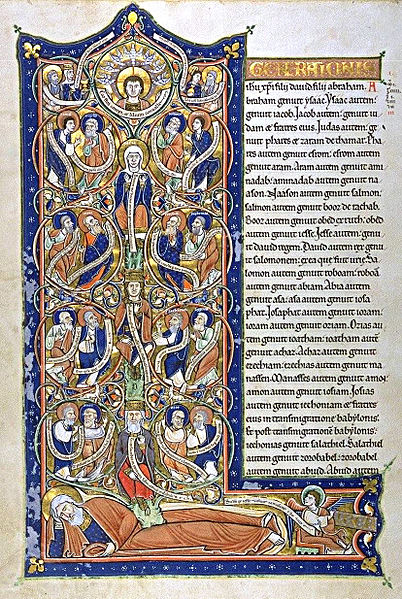
The first section I had to tackle was the book’s opening genealogy. It contains two famous puzzles. The first has already been discussed in an earlier post: Why does Matthew omit three names, jumping from Joram to Uzziah? (This was evidence for Dr. Kline’s “gap theory” of the biblical genealogies.) The second puzzle is why Matthew’s lists still do not add up to the 14-14-14 pattern he specifies.

There are fourteen generations “from Abraham to David” if the first and last figures are both counted, but fourteen generations “from David to the exile” (i.e. to Jeconiah) only if the first figure is not counted. The final series works only if the first and last figures are once again counted, or, alternatively, if Mary is counted along with Joseph, even though they belong to the same “generation.”

The solution to these puzzles, as I suggest in that earlier post, is that Matthew is presenting a portrait of the Messiah as coming at the beginning of the seventh seven of generations in Israelite history. The first, third, and fifth “days” in this “week” of seven-generation days begin at significant redemptive-historical moments: the call of the patriarch Abraham; the foundation of the royal house of David; the destruction of the first temple. The actual historical generations involved are compressed or stretched as necessary in order to accommodate this scheme. The final effect is the portrayal of Jesus as arriving at (indeed, as constituting) the beginning of a time of spiritual rest and renewal in the life of the nation, corresponding to the concepts of “sabbath” and “jubilee” in the Old Testament. Genealogy provides the canvas on which this portrait is painted, but what we have before us is clearly closer to art than history.

As I prepared a Bible study outline for this passage, I referred my students by way of analogy to the similar but much more elaborate redemptive-historical patterning found in the Book of Jubilees, a non-biblical Jewish work from the second century before Christ. According to this book, Moses was given the law on Mount Sinai 2,401 years, or (7×7)x(7×7) years, after the creation.

I also called attention as well to other genealogies in the Bible that are similarly shaped by artistic and theological designs. The principle of artistic arrangement can be seen in parallel genealogies in Genesis that portray two lines of descent from Adam. The line of Cain, who is cursed, is traced to seven generations; the last figure, whose story is expanded, is described as the father of three sons. The line of Seth, given by God in place of righteous Abel, is traced to ten generations; the last figure, whose story is expanded, is similarly described as the father of three sons.

A more elaborate example is found at the beginning of 1 Chronicles. The sons of Jacob, when first enumerated in this long genealogy , are grouped according to their mothers: first Leah’s sons, then Rachel’s, then Bilhah’s (Rachel’s handmaiden), then Zilpah’s (Leah’s handmaiden). There is one prominent exception: Bilhah’s son Dan is listed right after Leah’s six sons. But the records of the descendants of each of Jacob’s sons are not then elaborated in this order.

Rather, the genealogy develops politically and geographically. Judah is listed first, because the royal house of David is Judean. Simeon, who territory was integrated into the southern Judean kingdom when Israel was divided, is listed next. The territory of Benjamin also formed part of the southern kingdom, but Benjamin’s descendants are described last of all, to de-emphasize the tribe that produced the abortive royal house of Saul. After Simeon come instead the two and a half tribes who settled across the Jordan and were taken into exile earlier than the rest (for idolatry, we are told): Reuben, Gad, and Manasseh. The Levites, whose cities were scattered throughout Israel, are listed next. Then come the tribes that made up the northern kingdom, with one significant exception: Dan is never mentioned at all. Given his prominence at the opening, we recognize that this is deliberate. When we recall that the Danites were notorious as the first idolaters in Israel, we see that this “genealogy” is being shaped as an emblem of Israelite history and geography, and particularly as a warning against idolatry.

Such examples helped me explain, in the Bible study I was leading, how the genealogy in Matthew develops and how it “works.” But they were helpful to me personally for another reason. The background research I did for this lesson fixed firmly in my mind the principle that the genre of genealogy in the Bible uses “history” only as a jumping-off point for theological statements that are made through artistic portrayals. Biblical genealogies are historical only secondarily, in other words. This being the case, it is not appropriate to use them, especially not cumulatively, in seeking to answer historical questions such as the duration of human civilization or the age of the earth.

So my years in graduate school, my pursuit of the ordination process, and my service in a local church gave me the opportunity to reflect in depth on my theological convictions and on their biblical foundations, and specifically on these questions relating to the issue of human origins.

Matthew’s genealogy of Jesus was presented in medieval manuscripts as a “Jesse tree,” as in this example from the Bibliothèque nationale de France. (Courtesy Wikipedia, public domain.)

30 Snow melt

Gasson Hall, Boston College

One sunny winter day while I was doing my doctorate (whose story I’ll introduce near the end of this post), I sat by a window in the Boston College library. A loud swishing sound interrupted my reading. I looked up just in time to see a heavy column of snow slide down a broad chute formed by the corrugations of the copper roof on an adjacent building. Other columns made similar downward flights throughout the afternoon. The sun had been slowly, indiscernibly melting the bottom of the snow until, column after column, it slid off the roof on a cushion of water. Sometimes changes that seem dramatic when they occur are actually the result of incremental influences that have accumulated over time.

This was the case with my ultimate abandonment of the belief that the earth was only a few thousand years old. I never experienced “rock shock” the way my brother-in-law did. (This may be because I’d held an “old earth” view as a child before becoming a creationist as a teenager, though I didn’t know enough to use those terms at the time.) But eventually a growing body of evidence, a more satisfying way of interpreting the Bible, and my increasing awareness of intermediate positions made me free to hold the all-or-nothing young-earth paradigm I’d been taught in creative tension with other possibilities. At one point, some of these other possibilities simply began to appear more reasonable.

As anticlimactic as it may sound, I accepted the reasonableness of the earth’s antiquity one day while sitting in my living room watching television! I’m not sure exactly when this incident took place, but it was in the years after I had left seminary and the ministry, while was working as a writer, and clearly some time after I taught my Genesis course. I was watching an educational program that was not primarily about evolution, but rather about a certain region of our country which is now inland and gently mountainous, but which also contains marine fossils. I was now somehow able to accept that the area had been covered by seas once; then mountains had thrust upwards; then these mountains had eroded. And this, I was able to admit, had to have taken a long time!

I still didn’t know how this recognition could be reconciled with the biblical chronology that, taken as a whole, seemed to require a young earth. But I felt that some explanation could eventually be found, and so my new time frame for natural history did not really upset my faith very much. Nevertheless, I did not rush to embrace a Darwinian model of biological development, either. I was still aware of enough unresolved problems within that paradigm that it did not appear to be a completely satisfactory account of the origins and development of life. So I moved from a position in which I had a personally satisfying and harmonious vision of science and the Bible to one in which I suspended judgment on many questions.

Five years after I left seminary, I returned to Gordon-Conwell to complete a master’s degree in theological studies, graduating in 1988. From there, after a year of further preparation, I entered the joint doctoral program of Andover Newton Theological School and the Boston College Department of Theology. At the same time, I accepted a call to the First Baptist Church in Newton as assistant minister, and I began pursuing ordination with the American Baptist Churches in the U.S.A. Each of these three endeavors presented challenges that at one point or another refined and shaped my understanding of the early chapters of Genesis.

First, during the fall semester of my first two years of doctoral studies, I met weekly in a colloquium with the other members of the program who were similarly still in course work. They represented different specialties: systematic theology, historical theology, and ethics. Many, like me, had Bible minors. Our task was to work our way through the Western theological and philosophical tradition by reading and debating the writings of its greatest figures.

In one of our discussions, a student, without using the actual term, characterized people as beset by “original sin.” Another student became indignant. “Come now,” he protested, “you don’t mean to tell me that there are people in this room who still believe in the myth of Adam and Eve!” A third student responded cautiously, “That depends what you mean by ‘myth.’” The rest of the group, knowing slim conversational prospects when they saw them, moved on to other issues.

But the question stayed with me. I did believe in “original sin,” in that I believed all people needed God’s deliverance from innate self-destructive and spiritually deadening tendencies. This is all my classmate had meant by the “myth of Adam and Eve” that he didn’t believe in. But did believing the story mean more than that?

I recognized that I now held two possibilities in creative tension: The human race may have been descended from a first pair, about which some historical details have been preserved; or, the story may have originated as an explanation and exposé of the innate destructive behavior patterns humans are only too ready to ignore or deny. The tension was tolerable, and thus did not cry out for immediate resolution, but at the same time it was creative and stimulated my thinking.

Another endeavor presented a second challenge to my thinking. As I moved through the ordination process in those same years I eventually wrote a paper, meant to be read aloud in my ordination council, describing my faith journey and sense of calling, and outlining my positions on a specified list of theological subjects. In advance of the council, I discussed my paper with ministerial preparation committees of my local and regional associations.

The draft I shared with the local committee included, under the subject of “creation,” the sentence, “Man and woman were made last but highest, to rule over creation as God’s stewards.” When I read this sentence, one minister on the committee said aloud, “No.” He insisted that man might have been made last according to Genesis 1, but that according to Genesis 2, he was created first. When I looked at him with uncomprehending eyes, he said simply, “Read it for yourself.”

We moved on, but when I got back to my office at the church, the first thing I did was read it for myself. And sure enough, he was right. More than a little embarrassed that I had never observed this before, my first step was to change my paper to read, “Humans were created with a special responsibility to superintend creation, as God’s stewards.” My next step was to figure out how the Bible could claim, in adjacent accounts, that man was created both before and after the animals.

29 New Paradigms in Biology and Biblical Interpretation

Around this time I also read an interesting book by Francis Hitching entitled The Neck of the Giraffe: Darwin, Evolution and the New Biology. It took its name from one of the famous unsolved problems of evolution: How did the giraffe get its long neck? The book was not by a creationist; its author didn’t even describe any religious beliefs he may have held. Rather, working within the evolutionary paradigm itself, he explained why more and more scientists were questioning the classic Darwinian model, in which all life arises gradually from a common source through beneficial mutations and the process of natural selection.

Such problems as the giraffe’s neck had so far proven insoluble within this model, and so, he reported, alternative avenues to understanding were being explored. These included the theory of “punctuated equilibrium,” in which different species come into being with relative suddenness (although nevertheless through processes such as Darwin postulated, including geographic isolation and natural selection), and the discipline of cladistics, in which species were grouped according to their significant characteristics. (At the time I thought that this was done without any conclusions being drawn about ancestry. I did not realize that one of the most fundamental assumptions behind cladistics was that evolution had indeed occurred, and that characteristics considered significant for classification were believed to have been evolutionarily-derived.)

I had typed a paper in college for a student who had researched theories of the origin of flight in birds; he had found all of them unsatisfactory. And so I already knew that creationists were not the only ones dissatisfied with a classic Darwinian explanation of natural history. These alternative approaches, particularly as I understood them, provided more middle ground for me to explore once I no longer felt compelled to believe in a recent creation based on biblical authority. (I’ll explain in a future post how that shift occurred.)

At this time I also read Northrop Frye’s book The Great Code: The Bible and Literature. I admired Frye as a literary critic, having come across his work in several of my courses at Harvard, and so I was eager to read what he had to say about the Bible. His book helped me continue integrating my thinking by giving me a model within which I could approach the Bible using the literary-critical skills I had been taught.

While living in Ottawa I taught several courses on biblical books for the evening extension program of the Ontario Bible College. For each course, I worked from a literary outline of the book we were considering, rather than from chapter divisions, which I now knew were often misleading and not representative of a book’s inherent developmental transitions.

A flyer from the program I was teaching in. The school later became part of Tyndale University College and Seminary.

I showed my students how the book of Hebrews, for example, alternates several times between exposition and exhortation, with clearly marked literary transitions. And when I taught a course on Genesis, I passed along the insight into its structure I had gotten from Meredith Kline, that the ten repetitions in the book of the phrase “these are the generations of . . .” mark off its major sections. “Generations” here means “things generated”; the “generations of Adam,” for example, are what Adam brought forth—not his genealogy. (After further study, I would now say that the Torah or Pentateuch is divided into sections by twelve repetitions of this phrase. There are actually 11 in what we know as the book of Genesis; Dr. Kline counted Genesis 36:1 and 36:9 as a single occurrence. The other is in Numbers 3:1.) My interpretive paradigm was becoming ever more consistently literary, not literal.

Within my Genesis course I naturally discussed the creation account. I first stressed, presenting the exegesis of that passage I had learned from Dr. Kline, that the most important thing, whether we took the chapter literally or not, was to appreciate its moral message. We needed to witness and participate in the “Sabbath enthronement of God” as the culmination of creation. This account does not “cater to our curiosity” about origins, I insisted. “What is that to you?” it asks, just as Jesus asked Peter when he inquired whether John would live until His return. “Follow me,” Jesus had said, and so we should also follow God without asking too much about things that were beyond us.

I did, however, share a few thoughts about whether we could legitimately take Genesis 1 as the grounds for believing in a recent creation. I observed first that “the poetic character of the passage is indisputable,” but added that “poetry can describe events that actually took place, so genre does not force a non-literal view, although it arguably permits it.” (By non-literal I meant one in which words and phrases are not necessarily descriptions, even figurative ones, of historical events.)

I then acknowledged the difficulties of a sequential, descriptive reading, specifically light on earth without the sun. The best resolution of this difficulty I could manage was to envision Genesis 1 as having been revealed from God’s perspective, insisting in my lecture, “There is not, as for us, with God a distinction between purpose and accomplishment, between seeing what does appear and what will appear. From the time God said there would be night and day, there was night and day. Nevertheless, as we all know, the sun gives light on the earth.”

I concluded with some objections that could be raised against the theory of evolution as a rival to the Genesis creation account, some taken from standard creationist arguments and others from sources such as The Neck of the Giraffe. My main point was that the prevailing belief about natural history had changed first, in response to the “spirit of the age” or Zeitgeist that emphasized “progress.” The physical evidence for evolution had come later, in the hands of people who were specifically looking for what they claimed to have found, but in many cases turned out to have been mistaken.

I noted the continuing gaps in the fossil record, which were leading to such theories as “punctuated equilibrium.” And I questioned the reliability of radioactive dating, noting that it depended on the assumption that the ratio of radioactive material to non-radioactive has remained constant throughout geologic time, an assumption incapable of scientific proof. I also noted the circular argument by which, in my understanding, the geologic time table had been constructed: Fossils were dated at a certain age because they were assigned to certain periods, but these periods were assigned that same age because they contained these fossils. My ultimate conclusion was, “if you want to believe that the earth is thousands of years old rather than millions, you are perfectly justified.”

So my seminary experience and my later reflections on it had brought me to a point where I could accept a poetic, figurative reading of the “days of creation,” but my understanding of the biblical chronology implicit in the genealogies running from Adam to later personages still committed me to a young-earth view. What science I knew did not present an insurmountable obstacle to this position.

However, I did have to respect the scientific expertise of one Christian I knew well, trusted, and admired, and his claims were becoming unsettling. In these same years my brother-in-law, Stephen Godfrey, became suddenly and deeply disillusioned with creationism. As he pursued his Ph.D. in paleontology, he began to complain the expectations about the fossil record he had had as a young-earth creationist were not being borne out in his field research. Now he didn’t know what to believe about creation and evolution, or about the rest of the doctrinal package that had come wrapped in the creationism he had been taught.

I didn’t fully appreciate the paleontology involved, but I knew him well enough to know he was not motivated, like the evolutionists I’d heard caricatured, by a desire for an ateleological natural world that would free him of moral responsibility. Clearly he had seen something in the ground that had shattered the “creation science” I was still considering reliable. I slowly began to hold this “science” at arm’s length, releasing my embrace of it and regarding it with a critical eye.

28 An old-earth “gap theory” of biblical genealogies?

I was won over to Dr. Kline’s “Framework View” on the textual level, I should specify. I wrote in my notes, “This exegesis is correct, but the implications with respect to chronology do not necessarily hold.” What I meant by implications was that a reading of Genesis 1 as “poetry” could easily allow creation to have taken much longer than six literal days, and thus would allow the earth to be very old. But I still did not consider this possible, because I continued to believe that I should establish my understanding of the earth’s age by beginning with the Bible, and that the Bible still only allowed this to be about 6,000 years, however long the original creation might have required.

I based this continuing conviction, even given my new understanding of Genesis 1, on the genealogies in the Bible that began with Adam and ran down to datable historical figures, providing the age of each father at the time of the birth of each son. Using these genealogies, Bishop Ussher had made his famous calculations that put creation in the year 4004 B.C. I had not made all the calculations myself, but six thousand years felt about right.

Dr. Kline was well aware of these genealogies, but still did not believe in a recent creation. He accommodated the vast ages of geologic time postulated by natural scientists by appeal to the possibility of “gaps” in the biblical genealogies. And here I thought I detected a bit of inconsistency on the part of the “old professor” (as he liked to call himself).

In addition to promulgating his own “gap theory” of genealogies, he emulated those who read “day” to mean “age” in Genesis 1 by sometimes reading “son” as “descendant” in the genealogies, and by sometimes understanding “begat” to mean “was the ancestor of.” To defend such readings, he called our attention to Matthew’s genealogy of Jesus at the beginning of his gospel (Matt. 1:1-17). In verse 1, Jesus is called the “son” of Abraham and David, even though he is a more distant descendant of each of these figures. And in verse 8, Joram is said to have “begotten” Uzziah, who was really his great-great-grandson.

But the same objections Dr. Kline had raised to popular interpretations of Genesis 1 could be leveled against his reading of the first chapter of Matthew. Is not its first verse a “summary introduction,” and is it not therefore unfair to read it as if it were part of the genealogy proper? And does not Matthew omit the kings between Joram and Uzziah in order to maintain a 14-14-14 pattern, to portray Jesus as coming at the beginning of the seventh seven of generations after Abraham, the generation of sabbath or jubilee? In other words, is he not really writing “poetry,” more than “genealogy”?

As I would later discover, all of the biblical genealogies have strong poetical aims and characteristics, obviating the need to read them literally and to postulate a young earth on biblical authority. But Dr. Kline had not carried his analysis this far, and so had to live with some interpretive inconsistencies. One day while carpooling to seminary the conversation turned to Dr. Kline’s reading of the genealogies. I said I was unconvinced, and thought he had adopted this interpretation mostly to accommodate the vast ages of geologic time somewhere in his reading of the Bible. The driver said, gravely, “I think we need to do that.” I still didn’t.

My other seminary courses were just as challenging and exciting. The year I spent at Gordon-Conwell in 1981-82 was a wonderful time of stretching and growing. But I didn’t return the following year, as I was reluctant to borrow heavily for my education and I wanted to invest some quality time in my still-new marriage relationship. (I concluded, finding reassurance in an analogy, that the exemption of new husbands from military service found in Deuteronomy should apply to seminary students as well.) Some friends in Ottawa, Ontario connected us with a small church there and I became its pastor.

Reflecting on the Scripture passage I’d shortly be preaching from at my first church.

After a little over a year, I found that I needed even more of a break and resigned my pastorate, eventually finding work as a writer in the Canadian Department of Communications, where I worked for more than three years. The time I spent out of seminary and then out of the ministry proved to be an excellent opportunity for personal growth and for the consolidation of my thinking on a great many previously-closed questions that seminary had opened. This included the question of the Bible and human origins.

At one point I struck up a correspondence with a friend who wanted to know how I, as an educated person, could continue to believe in a recent creation in the face of overwhelming scientific evidence that the universe is ancient. As I recall our exchange of letters on the subject, I felt I was being encouraged to embrace an ateleological world view. I shrank back from what I felt the moral implications of this view would be: “survival of the fittest” as the rule of relationships between people, with might making right.

My friend explained that these were not necessarily the implications of an evolutionary paradigm if the lesson of evolution for us was that humans had survived and thrived through cooperation among themselves. This was the first time it had been demonstrated for me that I did not necessarily have to make a stark choice between a creationist paradigm (unscientific, but moral), in which people are accountable to God for how they treat others, and an evolutionary one (scientific, but amoral), in which life consists of a ruthless quest for domination. There were some options in between.