Does the Hebrew verb bara‘ mean “assign a function” rather than “create”?

In this series of posts, I’ve been reviewing John Walton’s book The Lost World of Genesis One. After summarizing his interpretation of the Bible’s opening creation account in my first post, and discussing some concerns that his interpretation raises in my second post, I’d now like to address the issue that led a reader of Paradigms on Pilgrimage to call attention to Walton’s book in the first place. What precisely does the Hebrew verb bara‘ signify?

The word is usually translated “create” in English. However, one of Walton’s crucial arguments to support the idea that Genesis presents an account of “functional origins” rather than “material origins” is that this word actually means to give something a function, rather than to bring something into existence materially.

To support this claim, he surveys all fifty occurrences of bara‘ in the Hebrew Bible and concludes that “no clear example occurs that demands a material perspective for the verb, though many are ambiguous” (41). That is, in his view, many instances could describe either bringing about material existence or assigning a function. He adds in a footnote that “in a large percentage of the cases where the usage is ambiguous, a further explanation is offered that indicates a functional interest” (175–176). However, giving something a material existence out of functional interest, that is, so that it can fulfill a function, nevertheless constitutes a material creation. It’s not the same thing as assigning a function to an already-existing entity, which is the meaning required by Walton’s interpretation of Genesis as describing “days that concern origins of functions not material” (94).

I personally find that many of the uses of bara’ that Walton lists fit the meaning of material creation quite well. For example, Psalm 104 describes how animals “die and return to dust,” but it then says to God, “You send your Spirit, they are created, and you renew the face of the ground.” This is certainly not a case of previously existing animals being assigned the function of renewing the ground, because the previous animals have died and decayed. So new animals are being brought into existence materially. And it’s not precisely their function to renew the ground; rather, this is a function that God fulfills by making them.

But whatever the significance of bara‘ throughout the Bible (and the verb could indeed cover a range of meanings), we need to be most concerned with what it means in the Genesis account. As he makes his argument for a functional connotation there, Walton addresses the cases where it appears that things are being brought into existence materially. However, it seems to me that to do this, he actually departs from his commitment to read the text through the eyes of the ancient audience it was composed for.

Walton acknowledges, for example, that “day two has a potentially material component,” the firmament (raqi‘a), that is, the dome of the sky. But, he argues, “No one believes there is actually something material there . . . If the account is material as well as functional then we find ourselves with the problem of trying to explain the material creation of something that does not exist” (93). Actually, everyone acknowledges that there is something material there: Earth has an atmosphere. While it’s gaseous, it’s still composed of matter (and so “material” in that sense), and it indeed provides a habitation for life on earth, by contrast with other planets that lack atmospheres. The fact that Genesis regards the sky as solid rather than gaseous can be attributed to its observational perspective.

Walton grants that “raqi‘a had a meaning to Israelites as referring to a very specific object in their cosmic geography.” But he insists that “in the functional approach, this component of Old World science addresses the function of weather, described in terms that they would understand” (93–94). It seems to me that he actually slips into a “concordist” approach here: A detail that would have meant one thing to the original audience (the solid dome) is taken to represent something different from a modern scientific perspective (weather), and that is said to be its true meaning. I think it would be more consistent to say that when understood from the perspective of the original readers, the creation of the raqi‘a would indeed have constituted bringing something into existence materially. That being the case, Genesis was not for them strictly an account of functional origins.

The same issue arises with Walton’s treatment of the creation of light on the first day. Noting that the text says that “God separated the light from the darkness,” he insists that “this statement does not make any sense if light and/or darkness are viewed as material objects . . . because by definition they cannot exist together in any meaningful scientific or material way” (54). However, the issue once again is not what sense the statement makes from a scientific perspective. We may well expect that an ancient reader could imagine all the light God made being “gathered together into one place” (or perhaps, more accurately, into one time), just as the waters were gathered together into one place on the next day.

Walton encounters a similar problem with the creation of humans. He acknowledges that their creation appears to be material because the material from which they are made is actually specified—the dust of the earth. To address this difficulty, he draws a distinction between a “prototype” (“an original item that serves as a model for later production”) and an “archetype” (“a representative for all others in the class”). He then argues that “the fact that the ancient Near East uses the same sorts of materials to describe all of humanity indicates that the materials have archetypal significance.” Specifically in the case of Genesis, being made of dust “is an archetypal feature that describes us all.” It “therefore cannot be viewed as a material ingredient. It is indicative of human destiny and mortality, and therefore is a functional comment, not a material one” (69). Once more a pre-scientific detail of the text is being given a representative meaning.

In this case there is a problem as well with the proposed functional connotation itself. Genesis depicts God forming humans from the dust of the earth before they became mortal and were destined to die. Even if returning to dust is indicative of mortality, being formed from dust in the first place cannot be a reference to that. There was no function in the original creation that humans were meant to fulfill by dying.

Later in the book Walton seems to describe an actual material creation of humanity. He states that there was “substantive discontinuity” between “the creation of the historical Adam and Eve” and whatever processes brought about the elements that were already in existence when the Genesis account opens and are only assigned a function there. “Rather than cause-and-effect continuity, there is material and spiritual discontinuity” (138). If that is the case, then when God says, “Let us make mankind in our image,” God is certainly bringing something new into existence materially. If we instead see this statement as describing only functional origins—“let us give an already-existing pre-human hominid the function of bearing the image of God”—we have to admit that the Genesis account is misrepresenting how God actually made image-bearing humans, because it would be suggesting that this happened in a continuous rather than a discontinuous way.

Indeed, in Walton’s final analysis, Adam and Eve appear to be much more prototypes than archetypes. He acknowledges that the Bible differs from other ancient Near Eastern texts in depicting the creation of individuals, rather than the “mass of humanity.” He observes that Adam and Eve’s identity as historic individuals is “indicated by their role in genealogies” (138). But this means that they are the actual progenitors of the human race, and so they are not just “representative of all others,” but “original items” that are not just the models but the source of “later production.”

And if that is the case, then humans, along with light and the sky, are all depicted as material creations in the Genesis account. There is no reason, therefore, not to see everything else in the account as being brought into existence materially when God “creates” (bara‘) the heavens and the earth.

In my final post in this series, I will reinforce this point by briefly examining the word ‘asa (“make”) in the Genesis account. I will then address a few remaining concerns and offer some general conclusions.


The prototype for the Corvette, created in 1953, which served as a model for all later production. Were Adam and Eve “prototypes” for humanity—the beginning of all later production? Or does Genesis describe them simply as “archetypes,” as representative examples of their class?

Is the Genesis creation account an anthropocentric “cosmic temple inauguration”?

In my last post, I summarized John Walton’s interpretation in The Lost World of Genesis One of the Bible’s opening creation account. In this post, I’d like to address some of the concerns that his interpretation raises for me.

Probably the most significant one is that the Genesis account does not say explicitly that the creation constitutes a cosmic temple for God. This is actually a marked difference between Genesis and the other ancient Near Eastern creation accounts that Walton cites. One of his foundational principles is that while we must seek to understand Genesis within the context of ancient Near Eastern culture, we should also be very alert to ways in which Genesis distinguishes itself from that culture, and this appears to be one of them.

One Akkadian text Walton cites, for example, says of the situation before creation, “No holy house, no house of the gods, no dwelling for them had been created, all the world was sea” (78). In Genesis, by contrast, the problem is not that there is no place for God to live; it’s that there’s no place for anyone or anything else to live. The earth is “formless,” that is, undifferentiated, not separated into spaces where creatures can live, and so it is also “empty,” devoid of population. It is uninhabitable and therefore uninhabited. According to the interpretation offered in Paradigms on Pilgrimage, Genesis then describes how God brought about “a place for everything,” and put “everything in its place.”

But Walton, responding to the notion that “formless” (tohu) instead means  “without material form,” argues that the term actually “describes that which is nonfunctional, having no purpose and generally unproductive in human terms” (48). He reviews the twenty occurrences of tohu in the Hebrew Bible in order to find support for this meaning. I personally feel, however, that the idea of “uninhabitable” (because not ordered in such a way as to support inhabitants) fits many of these examples quite well. Job, for instance, speaks of desert caravans wandering off their routes into a “wasteland” (tohu) where they perish for lack of water. The clearest concrete expression of this idea is found in Isaiah’s statement that when God “fashioned and made the earth . . . he did not create it to be empty (tohu), but formed it to be inhabited.” Some more metaphorical uses of the term to mean “empty” and, by extension, “worthless,” seem to derive from this concept of being uninhabited. Even the sense of “unproductive” relates to the concept of an area being arid and barren, not able to produce food, and so unfit for human habitation.

So I would argue that the problem that is solved in the creation account is not providing a house for God, but providing hospitable spaces for the teeming variety of creatures who will embody, express, and enjoy God’s goodness and creativity, existing both to reflect these divine attributes and for their own sake, to experience their “day in the sun,” as we say in our book.

Indeed, it appears to me that Genesis pointedly does not speak of a temple, specifically in order to counter any notion that God might be confined within creation (i.e. that God is immanent but not also transcendent). In that way it’s expressing the same perspective that Solomon does in his dedicatory prayer for the Jerusalem temple: “Will God really dwell on earth? The heavens, even the highest heaven, cannot contain you. How much less this temple I have built!” Walton, however, says that this is one of the “passages in the Old Testament that suggest the cosmos be viewed as a temple” (83). I think he has a better case for a statement such as the one in Isaiah, “Heaven is my throne, and earth is my footstool. Where is the house you will build for me? Where will my resting place be?” However, even the description there of God’s greatness in cosmic terms seems designed to make the same point, that God cannot be contained in any temple.

Other Scriptures support the idea that God made the cosmos as a dwelling place not for himself, but for creatures and especially humans. Psalm 115 says, “The highest heavens belong to the Lord, but the earth he has given to mankind.” (The “highest heavens” or “heaven of heavens” are beyond the sky or firmament, and so they are not part of the creation described in the Genesis account.) Psalm 11 expresses the similar thought that God dwells in the heavens while people dwell on earth, and it adds the idea that God’s temple is to be found there above: “The Lord is in his holy temple; the Lord is on his heavenly throne. He observes everyone on earth.” Throughout the Bible this same understanding is expressed of God’s temple being in heaven, i.e. beyond the sky. The book of Hebrews, for example, stresses that any earthly sanctuary is only a “copy and shadow” of the “true one” in heaven. It’s only at the end of the Bible that the heavenly Jerusalem descends to earth and we hear the proclamation, “Look! God’s dwelling place is now among the people.” This holy city has no physical temple “because the Lord God Almighty and the Lamb are its temple.”

Genesis, however, does speak of God establishing and consecrating the Sabbath, and I agree with Walton that the Sabbath reflects God’s reign, and perhaps even enthronement, as “the entire created structure pauses to acknowledge its Creator” (as we put it in our book, when I describe the views of my seminary professor Meredith Kline). However, this only leads me to conclude that the Genesis account should be seen not as a temple inauguration text but as a Sabbath inauguration text, particularly in light of the way appeals are made later in the Hebrew Bible to the account to support Sabbath observance. The Genesis account is not about a place for God to rest, but a time for God to rest. That’s why it’s structured by “days.”

I personally find the idea very appealing that the cosmos would serve as a “resting place” (or a “stopping-over place,” as some of the ancient Near Eastern texts say) for God. This affirms the dignity and worth of creation, and encourages us to be good stewards. It also stresses that God is not only transcendent but also immanent. So the metaphor of the cosmos as a temple for God is powerful and challenging. I’m just not convinced that this metaphor is being developed in the Genesis creation account. I agree it’s what Genesis would be saying if it were saying the same thing as other ancient Near Eastern creation accounts, but that’s precisely the question we must investigate—whether Genesis is indeed saying the same thing.

Another concern I have about Walton’s interpretation is that in the Genesis text, the elements of creation don’t actually fulfill primarily anthropocentric functions. He says of the sun, moon, and stars, for example, “The fourfold description of functions (signs, seasons, days, years) are pertinent only to humans” (63). (He rightly observes that “seasons” here doesn’t refer to agricultural seasons but to “appointed times.”) Nevertheless, as he acknowledges, these lights in the sky also have other functions, including giving light on the earth, which would benefit all creatures, and separating the light from the darkness, that is, distinguishing the realms of day and night. The Hebrew Bible seems to consider these realms-of-time to be just as distinct habitations as realms-of-space. Psalm 104 says, for example, “You make darkness, and it is night, when all the beasts of the forest creep about. . . . When the sun rises, they steal away and lie down in their dens. Man goes out to his work and to his labor until the evening.” So certain animals “inhabit” the night, while humans “inhabit” the day.

Beyond this, some of the created elements don’t actually fulfill the functions that Walton describes for them. For example, he says of the raqi‘a or “firmament” of the second day, “If the Hebrew term is to be taken in its normal contextual sense, it indicates that God made a solid dome to hold up waters above the earth” (56). He argues, however, that “instead of objectifying this water barrier, we should focus on the twofold cosmic function it played. Its first role was to create the space in which people could live.” (No argument there, although the dome actually creates a habitable space for all the other sea, sky, and land creatures as well.) “The second and more significant function was to serve as a mechanism by which precipitation was controlled.” Here two concerns arise. First, Genesis does not say anything about such a purpose or function for the firmament. More importantly, Genesis does say that it did not rain at this point in the history of the world; instead, “streams came up from the earth and watered the whole surface of the ground.” It was these streams, not “precipitation” controlled by the firmament, that made human life possible (specifically, watering the garden that God planted).

So those are some of the concerns that Walton’s overall interpretation raises for me. But we will now turn, in our next post, to the question of meaning of the Hebrew verb bara‘.

According to the Genesis creation account, just as boundaries were established between land, sea, and sky, the sun helped establish a boundary between day and night, which were also “habitations” for creatures. (Photo courtesy of TripAdvisor.)

Review of John Walton’s The Lost World of Genesis One

In response to an earlier post from our book (“It’s typical of God to begin a new thing by starting with something that already exists”), a reader offered the following comment:

John Walton claims (and I agree) that God’s act of creating (Hebrew bara‘) consists of (in my words) starting with a pile of something and separating it into 2 piles with different functions. I see this as extremely close to the idea of speciation (where one species branches into two) in the theory of evolution.

At the time, Dr. Smith responded:

Walton’s book The Lost World of Genesis One was published four years after ours, so I didn’t have the opportunity to discuss it in the course of my review of various understandings of the opening creation account. I plan to do one or more posts about it once the original Paradigms on Pilgrimage finishes running. I think it does make a valuable contribution to the conversation.

Here, and in the following three posts, is that promised discussion. [References in parentheses are to page numbers in John H. Walton, The Lost World of Genesis One: Ancient Cosmology and the Origins Debate (Downers Grove, Ill: InterVarsity Press, 2009).]


John Walton does appeal to a particular understanding of the meaning of the Hebrew word bara‘ to make the case for a new interpretation of the opening creation account in Genesis. However, the sense he finds in the word is not quite that of dividing something into two and giving each part a separate function. I’ll explore his understanding of the word in a later post, but let me begin here with some general observations.

Walton’s analysis of the creation account in The Lost World overlaps in many ways with ours in Paradigms on Pilgrimage. He rejects a “concordist” approach that “seeks to give a modern scientific explanation for the details in the text” (14–15). Instead, he says we should work to understand the account the way an ancient reader would have. When we do, we recognize that the creation is being described from “the perspective of the earthbound observer” (60) and that the picture in Genesis corresponds with the ancient Near Eastern cosmology in which the biblical authors were immersed: The sky is a solid dome, through which a moving sun passes above a stationary earth, etc.

Walton’s reading of Genesis is so much like ours, in fact, that he reaches many of the same conclusions we do. He insists, for example, that “by definition, empirical science is characterized by methodological naturalism, but once it begins propounding metaphysical naturalism, it has overstepped its disciplinary boundaries” (154). To argue for the valid conclusions of empirical science, he even appeals to the same “atheistic meteorology” analogy: “We believe that God controls the weather, yet we do not denounce meteorologists who produce their weather maps day to day based on the predictability of natural cause-and-effect processes. Can evolution be thought of in similar terms?” (135).

Probably the most significant similarity between Walton’s book and ours is that we are each seeking to encourage and empower believing Christians who feel called to work as scientists. Walton writes of “young people who were raised in the environment of a biblical faith” who “began to pursue education and careers in the sciences and found themselves conflicted as they tried to sort out the claims of science and the claims of the faith they had been taught.” Many felt that they were forced to choose either to believe the Bible and reject scientific discoveries, or else to reject the Bible in light of science. “The good news is that we do not have to make such a choice,” Walton reassures his readers (95). This is essentially the bottom line in our own book, and so Walton is ultimately an ally and a kindred spirit when it comes to understanding and articulating the relationship of science and faith.

That much said, however, there are significant differences between our interpretation of the Genesis creation account and his. Walton argues that this account is actually not a depiction of the material creation of the heavens and the earth. He does state, “I firmly believe that God is fully responsible for material origins” (42), but, he insists, “Genesis 1 is not that story” (95). Rather, “our affirmation of God’s creation of the material cosmos is supported by theological logic as well as by occasional New Testament references” (96). The Genesis account, by contrast, describes functional origins. Specifically, it recounts how things that were already in existence were given a particular function.

Before the events described in Genesis, Walton says, “the material phase . . . could have been under development for long eras . . . There would be no reason to think that the sun had not been shining, plants had not been growing, or animals had not been present” (96–97). But, he writes, “These were like the rehearsals leading up to the performance of a play. The rehearsals are preparatory and necessary, but they are not the play. They find their meaning only when the audience is present.” (97).

The “audience” that Walton has in mind is specifically human beings who have been “granted the image of God” and who can therefore serve him as “vice regents in the world that has been made for them” and as “priests” installed in the cosmos-as-temple so that God can be worshiped there. In other words, the “functional creation” that Walton sees depicted in Genesis is as follows: (1) specific elements are assigned the function of making human life possible (for example, the sun, moon, and stars mark off time); (2) humans receive the “image of God”; (3) God is enthroned in the temple of the cosmos. Walton therefore suggests that the whole account may be understood as a “cosmic temple inauguration” ceremony (86–87).

However, he specifies that “in Genesis, creation is not set up for the benefit of God but for the benefit of humanity—an anthropocentric view” (68). He asserts that the elements are assigned “human-oriented functions” (63) because the stage is being set specifically for humans to be given the function of bearing God’s image. This is essentially “what happens” in the creation account: Things that already exist materially are purposed to support that function. Walton speculates that “animal life, primates, and even pre-human hominids” (138) might already have developed through “evolutionary processes,” but he insists that before the action described in Genesis, “humanity in God’s image” was still “lacking” (96). God then brought about fully human people, “though it remains difficult to articulate how God accomplished this” (138).

Walton suggests that the Genesis creation account may actually have been used in worship, “as a liturgy to reenact (annually?) the inauguration of the cosmic temple” (98), and that if so, it may simply be offering a review of the arrangements that had already been made to support image-bearing humans, rather than a depiction of how these were first put in place. “The observer in Genesis 1 would see day by day that everything was ready to do for people what it had been designed to do. It would be like taking a campus tour just before the students were ready to arrive to see all the preparations that had been made and how everything had been designed, organized, and constructed to serve students” (98).

In a later post I will explore the meaning of the Hebrew verb bara‘, because one of Walton’s crucial arguments for seeing Genesis as an account of “functional origins” rather than of “material origins” is that this word means to give something a function. However, before examining the case he makes for that meaning, in my next post I will investigate some concerns and questions that his overall interpretation raises.

Fossils in life position (Part 3)

Young-Earth creationists are forced to claim that the overwhelming majority of fossils that appear to have been preserved in life position were actually not formed that way; they only appear to have been, as a serendipitous result of the vicissitudes of catastrophic burial during Noah’s Flood. That is a remarkable burden to bear.

At the onset of the flood (one can only imagine, since there are no natural mechanisms with which to work), organisms in life position would have been scoured and picked up by the catastrophe in order to populate all the sediments that were created and subsequently deposited by the flood. (Presumably sediments that might have existed prior to the flood would have been devoid of fossils.) Any organic remains deposited during the flood could not be in life position, since the rate of sedimentary accumulation needed to satisfy the creationist claim that the vast majority of global sediments were laid down in one year is vastly too rapid for organisms to establish themselves in life position.

For Noah’s Flood to have resulted in the formation of the fossil record, the only fossils that could be in life position would be those on the very bottom of the pile, or those at the very top, which would have reestablished themselves following the Deluge. (Creationists have not identified any such layers.) However, if you find just one fossil in life position (and all it takes is one) within a pile of sedimentary rock, what you then know is that the rate of sedimentation was slow enough (or no sediments were being deposited) so as not to interfere with that sessile organism for however long it lived at that level within the strata.

Seeing fossils like the oysters I’ve described preserved in life position is a very simple yet powerful way to refute the claim made by young-Earth creationists that the fossil record is the result of a global Noah’s Flood. What these fossils prove instead is that there must have been a period of time, at a minimum equal to the age of the oyster reef, during which sedimentation rates were very low. That period of time during which those oysters were living in this one place far exceeds the total duration of Noah’s Flood as described by young-Earth creationists. Add to the age of the reef the age of all the other fossils in the cliffs that are found in life position and one quickly realizes that the Earth must be much much older than 6,000 years.

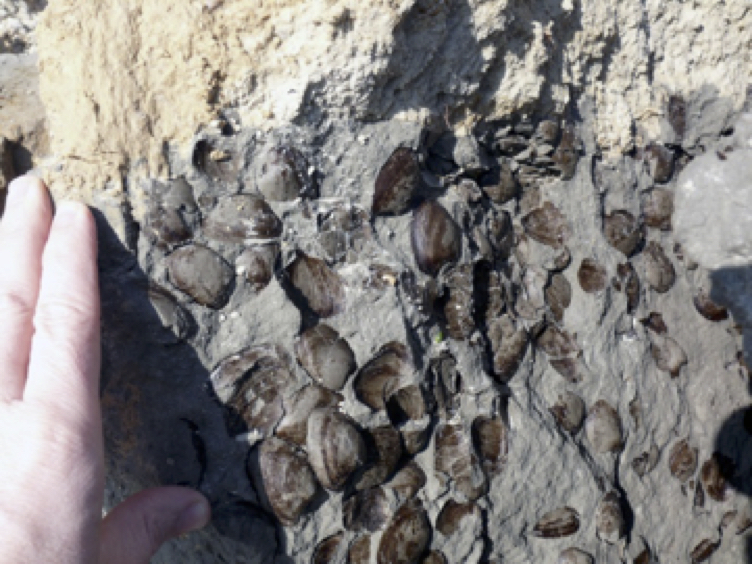
Fossil clam shells of the genus Glossus sp., preserved in the sediments in which they lived. These clams occur just slightly above the fossil Pycnodonte oyster reef. Just like in modern marine environments, these clams lived in great numbers in this exact place for as long as environmental conditions were suitable. Any one of these clams lived here longer than the purported duration of Noah’s Flood.

You too can know that the Earth is ancient just by knowing about fossils in life position, without having to understand the technical aspects of radiometric dating. (And, by the way, creationists should actually not acknowledge the existence of fossils at all, since by definition a fossil has to be at least 10,000 years old. Whenever creationists refer to fossils, they do so by changing the definition of the word, since according to them Noah’s Flood happened only about 5,000 years ago.)

But an ancient Earth doesn’t “disprove” the Bible. Descriptions of nature and the “cosmos” in the Bible were adequate at that time to make the spiritual points, if any, for which they were called into service. However, biblical cosmology is no longer adequate today if taken to stand on its own, divorced from its contextual origin. Some would argue that because the cosmology of the Bible is out of date, so too is its spiritual validity. Its cosmology roots the composition of the Bible in a time and place; so yes, it is out of date in its descriptions of the Universe. But I don’t know that justice, mercy, forgiveness, hope, and love have been replaced with something better. An emphasis on these could not wait until humans had figured out the exact nature of reality (we’d still be waiting). The Bible never makes the claim that its descriptions of the physical universe are good for all peoples for all time, whereas it does make certain pronouncements about being a guide to whoever has an interest in being right with God.


Dr. L. Ward (Virginia Museum of Natural History) provided great assistance with some of the geological features described in this series of posts.

Fossils in life position (Part 2)

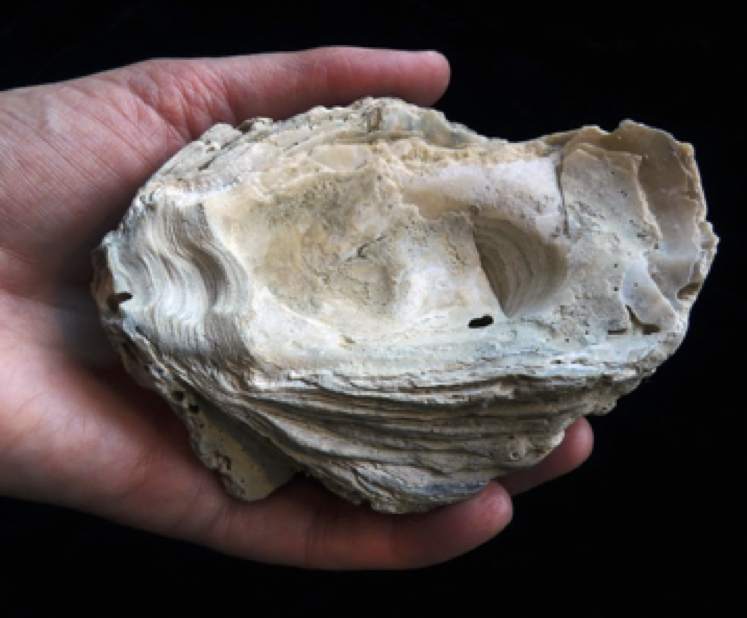
One valve (half-shell) of a typical Miocene Pycnodonte oyster from Bed 4 of the Calvert Formation, Calvert Cliffs, Maryland. An old individual showing many growth lines that was collected from the reef shown in the previous post.

The presence of the fossil oysters that I described and illustrated in my previous post demonstrates several things.

• Like living oysters, they formed reefs—vast concentrations of individuals belonging to the same species.

• Before the oyster reef formed, about 2600 feet of sediment had already been deposited in this place.

• This prehistoric reef began when, at some point in time, environmental and substrate conditions were just right for baby oysters (larvae) to settle to the sea floor and begin growing shells. The oysters began to grow on blue marl, i.e., a clay layer that had been previously compacted and then extensively burrowed by marine invertebrates (mostly crustaceans). They did not begin to grow here during Noah’s Flood, which, as characterized by young-Earth creationists, was global and catastrophic, during which sediments that were tens to hundreds to thousands of feet thick were being deposited daily; sessile organisms (or any organisms for that matter) do not live in those kinds of conditions. None of the sediments along Calvert Cliffs show any evidence of having come about through catastrophic flood-like conditions.

• Once baby oysters begin growing on the sea floor, they are incapable of moving from that spot for the rest of their life (their shell is just too heavy).

• These large and thick-shelled oysters lived for many years in the same spot (or within inches) in which they are now preserved. One of the ways that you can know that these oysters lived here is that they are so well preserved with many shells preserving both valves intact. This is an observation that Thomas Say made back in 1824 of other fossil clams from Maryland. He wrote: “Many of these shells appear to the eye nearly perfect, in every respect, with the exception of color, as the recent ones of the coast, and not a few of the bivalves have both bivalves attached . . . circumstances which indicate an undisturbed deposition in the waters in which they lived.”

• And so these oysters did not live somewhere else on Earth and then were moved to this new spot as a result of Noah’s Flood. We know this because there are so many heavy shells of the same species present in one place. After 2600 feet of sediment had already been deposited in this place, Noah’s Flood could not have picked up these oysters from another intact oyster reef hundreds or thousands of miles away, transporting them together to then be dropped here, giving every indication that this is where multiple generations of shells spent all of their post-larval life. Nothing about these oysters lends any support to the suggestion that they never lived here but were only deposited here during Noah’s Flood.

• This oyster reef survived for at least as long as the age of its oldest member. That would be the minimum age for the age of this reef. Knowing exactly how long this reef survived here is not as important as recognizing that the individual filter-feeding oysters lived here for a length of time much longer than the duration of Noah’s Flood. Consequently, neither the sediments above or below these oysters could have come about as a result of this purported deluge. If these oysters represent a reef that existed prior to Noah’s Flood, then one must explain the origin of all the fossils in the 2600 feet of sediment below the reef. Alternatively, if this reef formed after Noah’s Flood, one has the burden of explaining when and how the 70 feet of sediments that now cover these oysters were deposited. There has been neither enough time nor the existence of environmental conditions suitable to accumulate the sediments lying above the reef (not to mention that all the other fossils above the oyster reef that are also in life position; they too demand slow rates of sediment accumulation).

• Oysters cannot survive if they are buried by sediment, so they were not living while buried in the sediment that now covers this extinct reef. Oysters don’t have long siphons (a fleshy tube allowing them to become buried in sediment and yet reach up through it to draw in water from the ocean bottom) and therefore don’t tolerate burial. Indeed, sediments were being laid down during the time that the oysters lived here; it’s just that the rate of accumulation was so slow that it did not interfere with the long life of these heavy-shelled oysters.

• This reef persisted at this precise stratigraphic level and in this exact geographic location for as long as environmental conditions were favorable for the growth and reproduction of the oysters. That the layer of fossil oysters is not really thick is clear indication that at some point, environmental conditions changed sufficiently to make it impossible for the reef to survive. Just like any other marine setting, environmental conditions did not remain the same forever, and eventually the water became too deep, which spelled doom for this reef.

• Sediments continued to accumulate slowly around the shells until they were completely buried.

I’ll conclude this series by discussing in my next post what implications  these facts about the oyster reef have for the claims of creationism and flood geology.

Fossils in life position (Part 1)

One reader of this blog asked how our beliefs might have changed or developed in the twelve years since our book was published. One answer is that if we were writing the book today, Dr. Stephen Godfrey would include additional material about fossils found in life position, which he feels provide a compelling counter-example to the claims of creationist flood geology. In this series of posts, he explains this phenomenon.


As Curator of Paleontology at the Calvert Marine Museum, I collect fossils in all kinds of settings. I see how and where they are preserved. I find that, remarkably, as I shall explain, they inform not only our understanding of nature, but also of the Bible, to the extent to which these understandings intersect.

A fossil is said to be in “life position” if it is found in sedimentary rocks in the same spatial orientation and geographic and vertical position within the strata as where it lived and died. The most obvious fossils preserved in life position are those from “sessile” organisms, that is, ones that could not move from where they were living because they were anchored in one spot. A few examples of such organisms include trees, oysters growing in an oyster reef, barnacles, stromatolites, sea lilies, and coral reefs. In addition to strictly sessile organisms found in life position, other kinds of organisms such as burrowing clams and brachiopods can also be found in life position, buried where they lived their life as filter-feeders.

Becoming aware that certain kinds of fossils are often preserved in a life position had a profound impact on my understanding that the sediments in which they are buried could not have been deposited during Noah’s Flood (described by young-Earth creationism as a global catastrophe). Recognizing this phenomenon is also one of the easiest ways to know that the Earth is much older than young-Earth creationists believe. It is also one of the fundamental characteristics of the fossil record.

To be clear, there are many more examples of fossils, like sharks’ teeth, that are not found in life position. There are no permanently sessile sharks. Throughout their life, sharks move about, shedding teeth periodically. When a shark tooth is found in sedimentary rock, we rightly conclude that that tooth did not form and exist onlyright where it was found; rather, it came to rest there and was buried after it fell from a shark’s mouth (or the shark died and was buried in the vicinity of where the tooth was recovered).

However, there are other large categories of fossils preserved right where they were made by the living animal. These include fossilized footprints and burrows, which could not have been moved by Flood waters to their final resting place. Prehistoric burrows into sediments are also preserved right where they were made and did not settle out of Flood waters. Both of these kinds of fossil types are found at countless levels within the global record of sedimentary rocks.

There are many examples of burrows and fossils preserved in life position along Calvert Cliffs. There are literally trillions preserved in the geologic formations that make up the naturally eroding sea cliffs along the Chesapeake Bay.

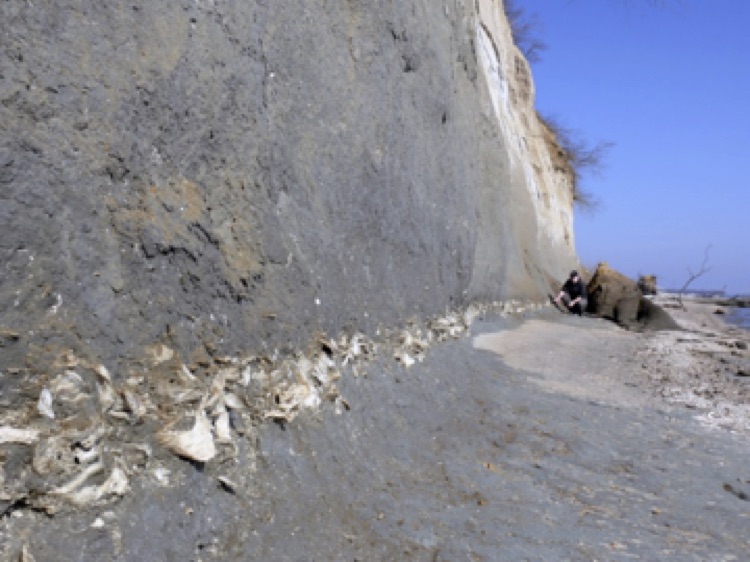
A view of Calvert Cliffs just south of Bay Front Park, Calvert County, Maryland, U.S.A. Notice the person in the lower right-hand side of this photo standing at the base of the cliff. Immediately above the clay sediments on which this person is standing is a fossilized oyster reef, which is shown in greater detail in the two pictures below. (Photo by S. Godfrey.)

As impressive as these sea cliffs are, they represent only the top 3.5% (about 80 feet) of a much thicker (2700-foot) pile of sediments hidden underground. What’s even more impressive is that this depth of sediment is only the narrow end of a vast wedge of sediment that thickens increasingly to the east, out under the waters of the Atlantic Ocean to the continental slope, where the pile is 10-14 km thick! These sediments, consisting of a mixture of sand and clay, eroded from the Piedmont and Appalachian mountains. The fossils found along Calvert Cliffs include the remains of over 600 different kinds of mostly marine organisms; these include a great variety of seashells (clams, oysters, and snails), sharks’ teeth, and whale and dolphin bones.

Fossil seashells, some forming thick layers, occur throughout most of the sediments that comprise Calvert Cliffs. At the northern end of Calvert Cliffs is a layer of heavy-shelled extinct oysters. In the next picture, notice the prominent layer of oyster shells at the base of the cliff, to which the individual in the distance is pointing. These oysters are among the most obvious and easily accessible examples of fossils preserved in life position along Calvert Cliffs (although there are many others). These shells are from an extinct kind of oyster, Pycnodonte percrassa.

A view along the oyster reef at the base of the cliff seen in the picture above. At this spot the Pycnodonte oyster reef formed on a heavily burrowed blue marl (clay layer).
Close-up view of the heavy Pycnodonte oyster shells. Fingers for scale.

In my next post, I’ll explain what we can conclude about the formation of these fossils from their occurrence in life position.

Are the Bible’s theological claims invalidated if they rest on literary rather than historical grounds?

This is another question that has been posed by a reader. Dr. Smith is answering it because it has to do with biblical interpretation.


Q. To what degree do claims involving spiritual matters depend on the correctness of the physical understanding that prompted them? Clearly, as with Jesus’ parables, you can have spiritual truth communicated through events that never happened. However, for those, the literary genre  precludes the historicity of the events described. Would you say that there are other categories of truth such as literary truth that might be somewhere in between physical and spiritual truth?

To take a different example, whatever view one takes of Jesus’ omniscience while he was a man on earth, one can always extricate him from any factual errors by arguing that, as God did throughout the Bible, Jesus was simply accommodating the knowledge of his audience to communicate spiritual and theological truths (e.g. with his statement about the mustard seed). When it comes to the apostles, though, they seemingly believed in a historical Adam and Eve, but one can’t really argue that in fact, they knew better but were simply accommodating the knowledge of their audience.

So if an argument that has spiritual ramifications is based on a reading of nature or history that is potentially flawed, how does one responsibly handle the spiritual points being made? Another example might be points made by the author of Hebrews based on Old Testament events that may or may not have happened quite as described in the Bible. Should one just abstract or extract inerrant theological truth based on the author’s likely understanding?

A. For one thing, many of these problems go away when we have a better understanding of the biblical culture and language. For example, Jesus’ statement that the mustard seed is “the smallest of all seeds” is often cited (sometimes gleefully) as proof that he wasn’t omniscient, because there are all kinds of seeds that are actually smaller. However, this is the kind of statement that’s made in Hebrew all the time to express extreme rather than superlative meaning. It’s like when a person says, “That was the best party ever!” While that’s a superlative statement, we shouldn’t take it literally and undercut it by saying, “I don’t know, back in ’02 we had a party that I think was probably better.” The person is actually saying, “That was a very good party!” And Jesus, for his part, is really saying, “The mustard seed is a very small seed, but it grows into a large plant.” An additional shade of meaning may be, “The mustard seed is the smallest seed you’re familiar with,” i.e. “I bet you can’t think of a smaller seed than the mustard seed, but what a large plant grows from it!” We are taking our modern, rational mindset and trying to impose it on statements that are hyperbolic and poetic, and that’s where the trouble often comes from.

On the other hand, I don’t see any need to defend the idea that Jesus was omniscient on earth. I believe he actually could have had a limited knowledge of world-wide botany, among other things, because the Bible itself says very clearly that he “emptied himself” when he came to earth. Most interpreters understand this to mean that he emptied himself of the so-called “non-communicable” divine attributes, i.e. those that God doesn’t share with humans, such as omniscience, omnipotence, and omnipresence. But Jesus retained the “communicable” divine attributes such as holiness, wisdom, etc. In that way he’s an example for us, showing us that we can share those attributes as well. So I would not argue that Jesus knew better but was simply accommodating the limitations of his audience when he made statements such as that God “causes his sun to rise on the evil and the good.” We know that the sun doesn’t actually rise; the earth rotates. But Jesus, when on earth, may well have believed in a stationary earth around which the sun revolved. No biggie.

The book of Hebrews is a very interesting case not because it appeals to  events that may not actually have happened in history (I’m not aware of any cases of that), but because it relies on the Greek Septuagint rather than the Hebrew Scriptures and so makes some linguistic moves that would not be possible from the Hebrew text. For example, it quotes the phrase “a body you prepared for me” from Psalm 40 in the Septuagint as support for the idea of Christ’s incarnation and the efficacy of his sacrificial offering of his “body.” The Hebrew text, however, actually reads “my ears you have opened.” I’ve addressed this issue of quotations that seem inexact in a post on my other blog Good Question (where there’s a link to my study guide to Hebrews, where I discuss the issue even further). The author of Hebrews is always very careful with the text; he “sees Christ as culmination of the story of God’s covenant dealings with humanity, and so earlier figures, events, institutions, and objects are seen as prefiguring his life and work. There is always a close and appropriate thematic connection between the earlier context in the First Testament and the situation in the life of Christ.”

Nevertheless, the bottom line is that all of us read and understand the Bible within a culture-bound tradition of interpretation. Another example of this is how Paul, speaking of the Israelites in the wilderness, refers to “the rock that followed them.” He’s adhering to a rabbinic interpretation that grew up in response to the question, “How could the rock that Moses struck in one place in the desert have provided water for the Israelites all throughout their journey?” The rabbinic answer was, “The rock must have followed them around, all the way to Canaan.” Now the Bible says nothing of the kind, and we can be pretty sure that this didn’t happen historically. But Paul is assuming this as a fact because he’s operating within a particular tradition of biblical interpretation.

This kind of thing is simply inevitable, because we are time-bound, history-bound, culture-bound humans. We can see it more clearly in the case of the biblical authors because we’re looking in from outside their framework. It’s harder for us to see in our own case because we’re within our own framework and so we don’t recognize what comes from it and what comes from the timeless redemptive work of God that the Bible captures. Perhaps it does not capture it completely, any more than a painting can capture an scene, but it does so at least as accurately as a painting captures a scene. (Though one limitation we experience because we are operating within a particular tradition of interpretation is a difficulty with statements that don’t make sense within our rational-scientific framework, e.g. that the mustard seed is the smallest of all seeds. These difficulties should not cause us problems with our faith; they should make us recognize and contextualize our framework.)

However, I think that the issue of the New Testament epistle writers not only believing in Adam and Eve as historical individuals, but basing significant theological doctrines on this belief, is something different that goes beyond anything I’ve addressed so far. Still, many of their statements are actually not as problematic as some might feel. For example, consider Paul’s statement, “I am afraid that just as Eve was deceived by the serpent’s cunning, your minds may somehow be led astray from your sincere and pure devotion to Christ.” This is a warning against false teachers and an expression of Paul’s concern for his spiritual flock in Corinth. It would not be invalidated if the episode of Eve and the serpent were literary but not historical.

We also hear many appeals, especially by “complementarians,” to Paul’s supposed argument that women should not be in authority over men because Eve was created second and was deceived, while Adam wasn’t. But as I understand it, this is actually a refutation of a proto-gnostic myth that the creator God was not the true God and that Eve (or Zoe) brought the knowledge of that fact to earth. (I discuss this in another post on my blog Good Question.) In other words, the problem here goes away when we understand the true message of the passage.

Probably the most serious issue arises from Paul’s depiction of Christ as the “second Adam.” However, even in this case we need to realize that Paul sees Adam essentially as a representative human (the “federal head” of the human race, as some theologians would put it), not primarily as a historical individual. And this is in keeping with the portrayal in Genesis itself, where the term ‘adam refers sometimes to an individual, sometimes to the first couple, sometimes to the human race, and sometimes to the entire created order. I’m confident arguing that Paul, a rabbi steeped in the Hebrew Scriptures, would have had this notion essentially in mind, rather than the modern individualistic notion of Adam being important and significant primarily as a single historical person. This is another case where the theological argument is not invalidated if Adam is a literary figure rather than a historical one, particularly when when we realize that in the original literary presentation itself (in Genesis), he’s not just a historical person.

Still, I may not yet have given a definitive answer to the question of whether a theological claim apparently built on a historical figure or occurrence is invalidated if that figure or occurrence turns out to be  literary instead. This is because example after example turns out to be not quite a case of that. But let me say generally that the real issue here is probably, “Where does the inspiration and authority of the Bible lie?” Some would say that it’s in the actual words of Scripture themselves (“verbal plenary inspiration”); others would say that it’s in the biblical authors’ intended meanings (many inerrantists argue this). But I believe that the authority of the Bible lies in its testimony to the redemptive works of God in history—in other words, it’s the divine acts that are authoritative and revelatory of God’s character and purposes. However, we don’t actually have those acts themselves. We have the story of those acts. So effectively, all we really have as an authority is the story. In that sense, maybe trying to draw too strict a distinction between what is “literary” and what is “historical” is not a meaningful exercise. God has given us access to his character and purposes through his acts in history, but he has given us access to those acts through the biblical story.

This is not all tied up in a neat bundle, I realize, but I don’t think it can be. In one sense, trying to use the discipline of history to validate the biblical account of God’s redemptive activity (or else to create a counter-story or meta-story to which the biblical story needs to conform if we are to respect and believe it) is a lot like trying to use natural-scientific disciplines to confirm the biblical account of God’s creative activity. We should recognize that we are dealing with different disciplines that answer different kinds of questions by following different “rules of the game.”

A question from a reader about methodological naturalism

The following question was submitted by a reader. The response is from Dr. Smith, since the question arises from his part of the story.


Q. In your book, following the Alters, you describe and define methodological naturalism over against metaphysical naturalism. These terms have become fairly mainstream in the science-faith discussion, as they potentially divide what theistic evolutionists consider valid science and what other groups like the Intelligent Design community consider scientific (e.g. scientific evidence of an intelligent designer in nature). Intelligent Design advocates are very critical of methodological naturalism and prefer the term methodological neutralism, or simply reject the distinction altogether. Some have defined methodological naturalism as either hard or soft (or strong/weak), where soft methodological naturalism simply excludes supernatural intelligence from consideration in science, and hard methodological naturalism excludes all intelligence from consideration in science. How would you potentially view the term?

A. I hadn’t been aware before of the discussion between theistic evolutionists and Intelligent Design proponents about methodological naturalism versus methodological neutralism, so I appreciate you bringing this to my attention. It makes perfect sense to me that Intelligent Design advocates wouldn’t want to accept methodological naturalism as an intrinsic commitment of science, because they want science to be able to declare that it has found evidence of supernatural activity. So this is really a debate about what science is.

People might understand and define the term “science” in a variety of ways, of course. But my belief is that science is rightly a discipline that limits itself to what can be observed and measured, and to explanations that involve causes that can also be observed and measured, i.e. natural causes.

One key principle of science is that findings have to be able to be replicated. I think we have to accept at least that as one of the “rules of the game.” But the findings of faith cannot be replicated by people who don’t have faith. So you really can’t mix the two categories. That being the case, if you’re looking at something that can’t yet be explained naturalistically, it’s not consistent with science to say that this must be due to a supernatural agency.

I personally don’t find the distinction between supernatural intelligence vs. all intelligence very meaningful. If something isn’t simply a process of nature, then any intelligence at work has to be super-natural. I guess on the spectrum you describe, I’d be considered a “hard” methodological naturalist, in that I don’t think science has any business positing supernatural explanations. But I don’t think it has any business denying that the supernatural exists, either; questions like that are the purview of a different realm—religion. (But I imagine it’s already clear from our book that this is my position!)

Is Genesis describing the creation of photons before the sun?

A reader has shared this observation about one part of Dr. Smith’s story:

I have a comment that you may find useful regarding the concern you express about the creation of light before the sun.

In my more recent reading, or at least since I took an interest in cosmology, I’ve taken a decidedly universal view of the creation account. That is, I see it as an account that refers to the creation of the Universe and not merely the Earth. In this view, the most resoundingly impressive statement is God’s very first act of creation, in which he creates light. I don’t see this as the creation of the light that strikes Earth, but rather as the creation of light itself—that is, photons—as well as the electrodynamic laws underpinning it that allow for a self-propagating electromagnetic wave.

In this context, the formlessness and void of the Universe before God’s creative work takes on a whole new depth. God did not merely create the Sun and the Earth, but created also the “form” of the Universe—previously without form, in addition to being empty—that allowed the Sun to create light and allowed light to travel to the Earth, and which allowed the Sun to hold the Earth through the force of gravitation. This is also the glorious power that I see in Jesus’ statement in his teaching on the Sabbath in John 5, where he says that His Father is always at His work. Indeed He is, as he sustains the physical laws as part of His perfect lordship of the Universe.

Dr. Smith replies:

Thank you very much for sharing your perspective on this. I think your understanding and interpretation of the creation of light before the Sun is certainly one of the positions that can validly be held about the Genesis account. But it does assume that the writer was allowed at least to describe things that would have been beyond the view of an earthbound observer, not to mention far beyond anything he could have understood meaningfully a thousand years or more B.C. So we have to ask whether God was simply using the Genesis writer to record words that would only be meaningful later, which raises questions about the “fully human and fully divine” nature of the Bible, or whether the writer thought the words meant something else, and humanity has only been in a position to recognize their real meaning and import in recent decades, which would raise similar questions.

That’s why I consider the account to have been written instead from an observational perspective by an earthbound observer and to say things that would have been meaningful at that time. From such a perspective, there really is light in the sky before the sun becomes visible, and the conclusion can be drawn that light creates a realm—day—in which the sun is the most conspicuous resident.

Nevertheless, I appreciate you sharing your perspective on the Genesis creation account. I think it’s very valuable for each of us to put our understandings and interpretations in conversation with those of others. Thank you!

Paleontologist Peter Dodson on science and faith

These reflections on science and faith were offered by Dr. Peter Dodson, a vertebrate paleontologist who is one of the world’s leading experts on dinosaurs, at the June 2017 Cosmos and Creation conference at Loyola University Maryland. His comments are shared here with his permission and have been edited slightly for length. They include a brief description of how our book Paradigms on Pilgrimage has been an encouragement to him.


What most interests me is the intersection of science and faith. Faith was as natural to me as breathing. I grew up in a Catholic household, attended Catholic high school and Catholic university. At Yale during my Ph.D. program my friends were for the most part Catholic. To be candid, I led a sheltered existence and was never seriously challenged in my faith. I never went through a period of doubt.

My bubble was burst in 1988 when I attended a seminar at the Academy of Natural Sciences in Philadelphia. The topic was “The Evolution of Human Morality” and the speaker was the late Wil Provine, an evolutionary biologist and evangelical atheist from Cornell University. His message was that we should face up to the consequences of what evolutionary biology teaches: “There is no God; there is no soul; there is no life after death; there is no such thing as free will. A scientist who professes to believe in God is a hypocrite. You MUST check your brains at the back of the church. Not more than a handful of evolutionary biologists believe in God.”

As I sensed the tacit or vocal approval of this message by the assembled scientists, I slouched deep into my seat, feeling most decidedly alone. I had never before heard such a crude expression of scientific naturalism, the gratuitous philosophy of materialism that science does not require. I of course knew that there are atheists in science but nobody before had tried to tell me I could not believe.

Father Hermann Behrens once said to me, “Peter, we should thank God for our enemies.” So true! Provine set me on a path that I am still following today, even this very morning. I became depressingly familiar with the village atheists—the Sagan, Dawkins, Dennett, Hitchens, Harris, Coyne, etc. crowd. But who could speak for the scientist as believer? My first task was finding those role models. Initially it was an effort. But they were there—first I found Polkinghorne, then Ian Barbour, Owen Gingerich and above all Gerogetown theologian Jack Haught.

But happily the literature has blossomed since and there are many titles we can turn to. Two of the highest profile books are The Language of God by Francis Collins and Darwin’s Gift to Science and Religion by Francisco Ayala. I am a huge admirer of Rabbi Jonathan Sacks’ The Great Partnership: Science, Religion, and the Search for Meaning. To this list I may add paleontologist Stephen Godfrey’s Paradigms on Pilgrimage, which documents his personal journey from Fundamentalism to acceptance of evolution while retaining his Christian faith.

For a number of years I thought my mission was to combat the errors and calumnies perpetrated by Dawkins and his legions. I no longer think that. Rather I believe it is much more important to make the case for our views and not against his. And here is the important part. We discuss our beliefs in the compatibility of science and faith because of the faith that we hold dear and cherish. We must be firm and bold in this faith. We must be willing to confess our faith and trust in the death and resurrection of our Lord Jesus Christ. Harvard astrochemist and Catholic convert Karin Oberg stated that she expected “a little martyrdom” when she arrived at Harvard. I find her courageous witness inspiring and worthy of emulation. Dare I say that we must be evangelical? By this I mean that we must encounter Jesus in the Scriptures and share what we learn.

St. Jerome states: “Ignorance of the Scriptures is ignorance of Christ, who is the living center of the Word of God.” Luther thought of the Gospel as sacrament—here we encounter Christ and his saving grace. We may read a familiar passage in Scripture 99 times, and the hundredth time it erupts “with an explosion of dazzling flashes” to use a Teilhardian phrase (via Tom King).

Such was my experience with Psalm 33, when I read in verse 4, “the works of the Lord are trustworthy”; and when I read this paraphrase of Romans 1: 20, “We shall know the Creator through the works of Creation.” Do these and a hundred other verses not give scientists like ourselves warrant to study the natural world as an act of praise to God? I do not regard the Bible as a scientific account of the natural world, but that in no way undermines my appreciation for the majestic words of Genesis 1 that we have just heard, concluding with its affirmation of the goodness of Creation.

I happily affirm that I am a Creationist—or more specifically a theistic evolutionist. The dialogue on science and faith that brings us together is enormously important, but it is not itself worship. It is incumbent on each of us to continue to grow in faith, in friendship with Jesus, and in knowledge of the Bible. As scientists we enjoy a certain status in society, and the more successful our science, the greater our potential for spreading the Good News—to our students, in our parishes, in our professional societies, on our web pages, in society at large. Be the best scientist you can be, and be the best Christian you can be. Who else is there to spread the message?